How Much Does an AI Agent Cost in 2026?
Compare AI agent build costs and monthly running costs, from DIY to enterprise. Break down API spend, hosting, maintenance, and when to build or buy.
TL;DR
- Separate one-time build work from recurring model, tool, hosting, maintenance, and review costs. A token price alone is not a workflow budget.
- Count tokens across every call and retry, then apply dated provider prices. Label worked examples as assumptions until you measure your own workload.
- Simple payback is build cost divided by positive net weekly savings. Time freed is not automatically cash saved, and nonpositive net savings give no finite payback.
I estimate an AI agent in two parts: one-time build work and recurring run cost. Add model calls, tools, hosting, review, and maintenance to the recurring estimate. A token price alone cannot tell you the cost of the workflow.
Correction, September 5, 2026: An earlier version of this post cited survey data and benchmark numbers without linked records, and used a payback formula that didn't match the math. Both are removed. What's below is rebuilt from primary pricing pages and clearly labeled hypothetical math, not measured results.
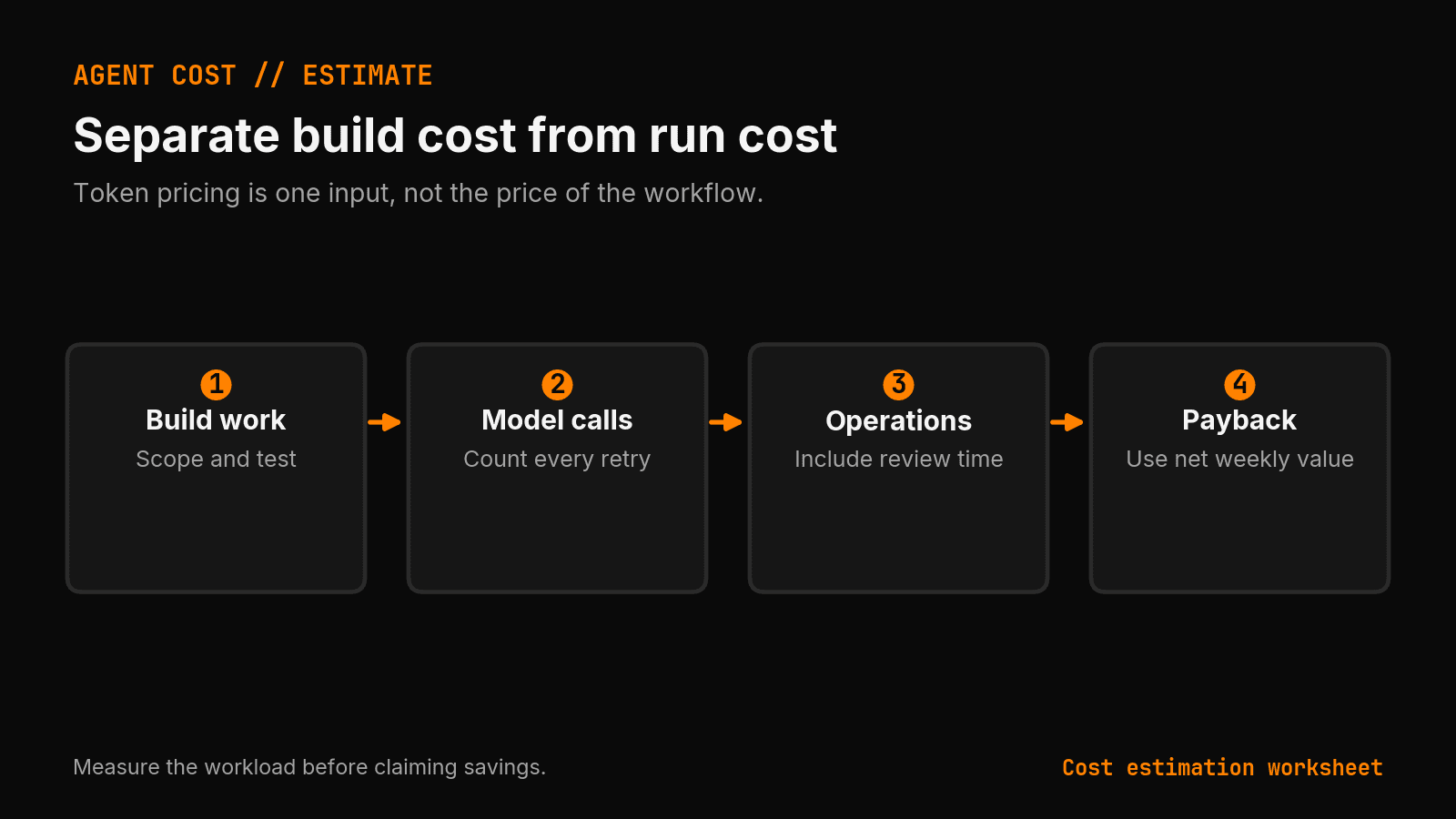
Build cost vs. run cost
Build cost covers design, code, tests, and deployment. Record the initial scope separately from later changes.
Run cost covers model and tool calls, hosting, monitoring, maintenance, and human review.
I do not have verified market-wide ranges. Scope, existing integrations, call volume, retries, and review effort determine your estimate.
DIY, platform, or custom build
DIY with an open framework. Estimate implementation and maintenance hours, even if you pay no contractor. Check whether you can test and support each integration.
No-code or low-code platform. Price the plan and usage limits against your required steps. Test a custom tool call, a retry, and a failed integration before assuming the platform covers them.
Custom build. Scope the workflow, failure handling, review steps, and ownership of maintenance. A custom contract does not guarantee correctness; include acceptance checks in the estimate.
None of these is right by default. Match the path to how often the agent runs and how costly a bad output is.
A hypothetical token cost calculation
Here's a clearly hypothetical example, not a real bill. Using Claude's published Sonnet 5 rates as of September 5, 2026: standard input is $2 per million tokens, output is $10 per million tokens, with cache pricing handled separately.
Say an agent runs 100 times a day, and each run totals 10,000 uncached input tokens and 1,000 output tokens across all calls in that run.
- Input: 10,000 tokens × $2/million = $0.02
- Output: 1,000 tokens × $10/million = $0.01
- Total per run: $0.03
- Per day (100 runs): $3.00
- Over 30 days: $90.00
That $90 is token spend only. More calls change the total. Tool charges, hosting, engineering, and review are additional. OpenAI also lists separate model and tool prices; use its current pricing page for the exact model and features you choose.
A hypothetical payback case
Here's a second, separate hypothetical: a $3,000 one-time build, $300 a week in time saved, and $50 a week in operating and review cost. Net savings: $250 a week.
Simple payback = build cost ÷ net weekly savings = $3,000 ÷ $250 = 12 weeks.
If net savings are zero or negative, there is no finite simple payback. Time freed is not automatically cash saved. Record how it gets used and check output quality before treating estimated hours as a return.
Local models change the math, not the rules
Local inference still uses equipment, electricity, setup, and maintenance. The consumer-GPU inference guide covers that deployment path. A subscription CLI uses its allowance and limits; do not budget it as unlimited free API access.
For a local support-ticket classifier, I would record accepted tickets, elapsed time, wall-plug energy, and reviewer minutes on the same test set used for the API option. Value the hardware and maintenance separately, then compare cost per accepted ticket at the expected volume. This is a comparison procedure, not a claim that I ran that benchmark or that local inference wins.
For controlling run cost once an agent is live, see AI agent cost control with AgentGuard in Python.
Cost worksheet
Before you estimate anything, fill this in:
- Build cost: hours × your rate, or the quoted price from whoever builds it
- Model and rate, with a link to the pricing page and the date you checked it
- Expected calls per run, and expected runs per day
- Input and output tokens per run, measured on representative inputs
- Retry rate and tool-call overhead
- Hosting cost, if self-hosted
- Weekly review time and its dollar value
- Weekly time saved, and whether that time converts to actual money
FAQ
How much does an AI agent cost? In the hypothetical example above, 100 daily runs cost $3 in tokens per day, or $90 over 30 days. That assumes 10,000 input and 1,000 output tokens per run at the linked rates. Add tool charges, hosting, and review separately. Keep one-time build work in its own total; this example is not a market average.
Is a cheaper model always cheaper to run? No. In a hypothetical comparison, three $0.02 attempts cost $0.06, while one successful $0.03 attempt costs $0.03. Run both options on the same test cases. Count failed attempts, tool charges, and reviewer time, then divide total cost by accepted results. This is a calculation example, not a measured model comparison.
When does a custom build pay for itself? The hypothetical $3,000 build above saves $300 a week and costs $50 a week to operate and review. Net savings are $250 a week, so simple payback is 12 weeks. Replace those assumptions with your measured costs and savings. Zero or negative net savings means no finite simple payback; time freed counts as cash saved only when spending actually falls.
Accompanying prompt
What the prompt does: Estimates build and run costs from your inputs, with dated price sources and an explicit payback calculation.
Copy/paste this prompt:
Copy-ready prompt
Paste the exact block into your coding agent.
No article chrome, no footnotes, no formatting drift.
This prompt and every other one we publish live in the free prompt library.
Copy the block above.
Set a maximum spend per run and a maximum number of retries before running unattended. For Python agents, use the AgentGuard runtime-control reference to configure the limits. Test a run that exceeds its budget and confirm it stops; a cost estimate alone does not enforce a spending limit.
FAQ
How much does it cost to build an AI agent in 2026?
Estimate one-time build work separately from recurring model, tool, hosting, maintenance, and review costs. Use your workload and dated provider prices rather than a universal build-cost range.
What are the ongoing costs of running an AI agent?
Running cost includes all model calls and retries, paid tools, hosting, monitoring, maintenance, and human review. Compare cost per accepted result, not just token prices.
Should I build a custom AI agent or use a platform?
Use a platform when its integrations and limits fit the task. Compare its subscription and usage costs with custom implementation, testing, and ongoing maintenance. Test failure handling before choosing.
Get the Local AI Field Kit
Four copy-ready tools now, then one evidence-backed Local AI Lab Note on Friday when there is something worth sharing.
Try the free agent run check firstGet the requested artifact now, then at most one evidence-backed Local AI Lab Note on Friday when there is something worth sharing. One-click unsubscribe. No sponsored placements. Privacy.
Patrick Hughes
I build BMD and publish measured AI runs, failure reports, and reusable checks. Nashville, Tennessee.
More writing
- 7 min
n8n vs Make vs Custom Code: 2026 AI Automation Decision Guide
Tested all three across 20+ real automations. n8n wins for speed, Make for non-coders, custom scripts when it gets complex. Side-by-side pricing, limits, and the exact use case each one owns.
- 4 min
A self-healing system can't heal an empty queue
Automated recovery only fixes a broken machine. When the real failure is an empty queue, retrying does nothing forever. Two failures, one red box, opposite repairs.
- 4 min
Missing AI agent cost data is not zero
A spend ledger that counts missing billing data as $0 hides exactly the unattended agent spend you built it to catch.
- 6 min
How to Close the AI Agent Cost Gap at the Call Site
The cost gap between what an AI agent could cost and what it does cost is 40%. You close it at the call site, not in a dashboard. Here is how.
- 4 min
When JPMorgan's AI bill goes up, who controls it?
JPMorgan turned on AI for 250k people. The quiet line is that the usage racks up fees. Here is how to control the bill before it arrives.