What Is auth.md? The Protocol for AI-Agent Signups (2026)
Agents fake their way through your signup form today. auth.md, WorkOS's open protocol already live at Cloudflare and Resend, swaps the form for a Markdown contract. Agent Verified vs User Claimed.
TL;DR
- auth.md is an open protocol from WorkOS. It lets an AI agent sign a user up without a signup form. Cloudflare, Firecrawl, Resend, and Monday.com have already shipped it.
- You host a Markdown file at yourapp.com/auth.md. The file declares how an agent may register a user. The agent reads it, follows the declared flow, and gets a scoped API key or access token.
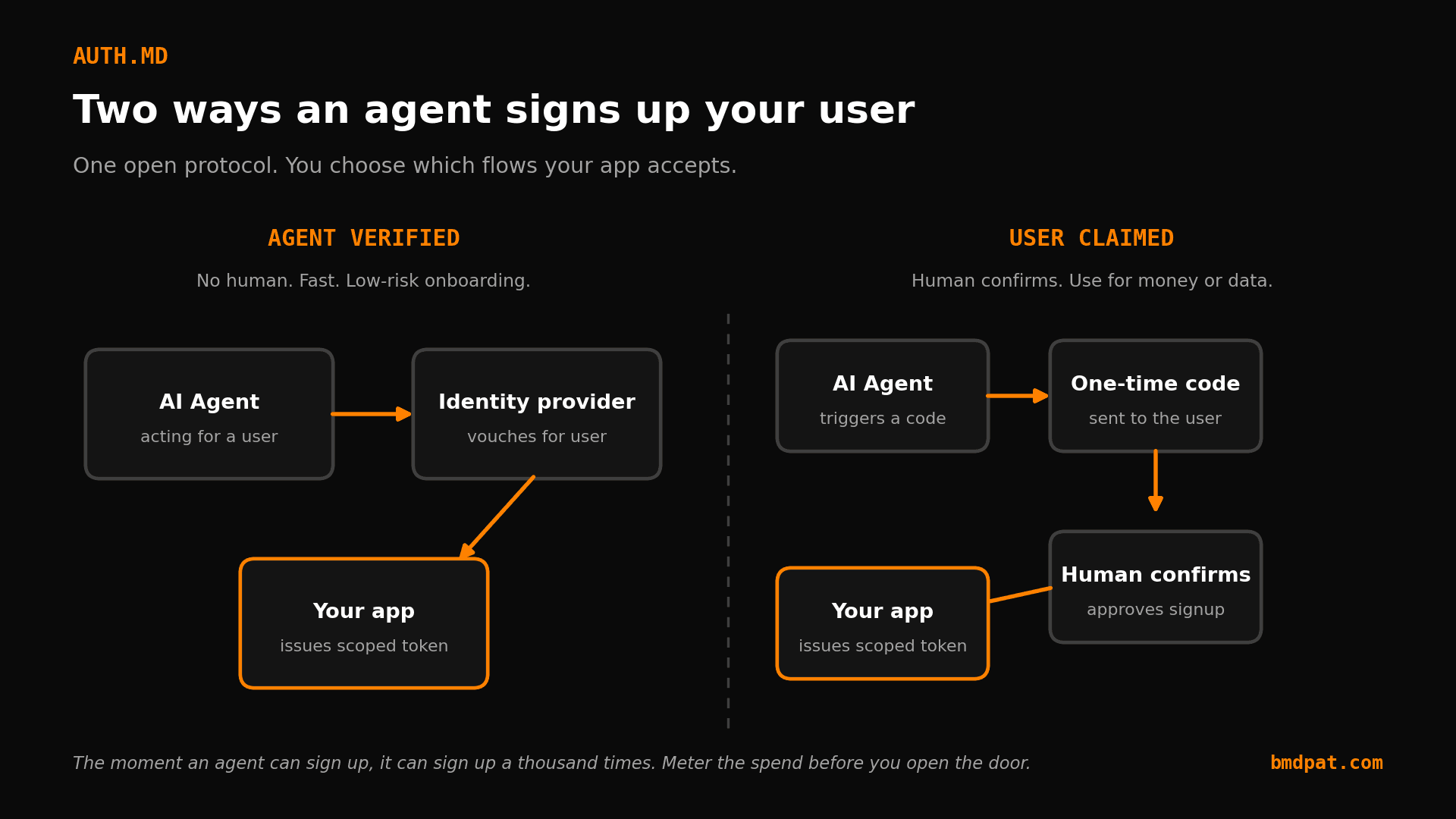
- Two flows exist. Agent Verified trusts the agent's identity provider with no human in the loop. User Claimed sends a one-time code the actual human confirms. Use User Claimed for anything that touches money or data.
There is a new open protocol called auth.md. It does one thing: it lets an AI agent sign a user up for your app without a signup form.
WorkOS published it. It is not locked to WorkOS. Cloudflare, Firecrawl, Resend, and Monday.com have already shipped it. If you build anything that an agent might touch, this is worth understanding now, while the term is still new and nobody is writing about it.
The problem it solves
Right now, agents fake their way through signup. An agent acting for a user hits your registration page, fills the form field by field, solves the captcha if it can, and hopes nothing changed since last week. It is brittle. It breaks on every redesign. And you, the app owner, have no idea a robot just created an account.
auth.md replaces the form with a contract. You host a Markdown file at https://yourapp.com/auth.md. The file declares how an agent is allowed to register a user. The agent reads the file, follows the declared flow, and gets back a scoped API key or access token. No form. No guessing.
If you have read about MCP, the mental model is the same shape. MCP lets agents use your tools. auth.md lets agents onboard your users. Same world, different door.
How it works
There are two flows, and you choose which ones you accept.
| Flow | Who vouches for the user | Human in the loop? | Use it for |
|---|---|---|---|
| Agent Verified | The agent's identity provider | No | Low-risk, high-volume onboarding |
| User Claimed | The actual human, via one-time code | Yes | Anything touching money or data |
Agent Verified. The agent's identity provider vouches for the user. No human in the loop. Fast, but you are trusting the provider's word that the user is real.
User Claimed. The agent triggers a one-time code. The actual human confirms it. Slower by one step, but a person signed off. This is the flow you want for anything that touches money or data.
You publish a Markdown file that says which flows you support, what scopes you grant, and what the agent gets back. The agent parses it and acts. That is the whole protocol. It is readable by a person and by a model, which is the point.
Why this matters more than it looks
Signup is the front door of every SaaS product. For ten years we built that door for humans: forms, captchas, email confirmation, onboarding tours. None of that works when the user never shows up and an agent comes instead.
The apps that adopt auth.md get a second front door, one built for agents. As more people run agents that buy, book, and subscribe on their behalf, that door starts mattering. The apps without it stay stuck with robots brute-forcing their human forms.
What breaks
This is the part the launch posts skip.
The second an agent can register itself, it can register a thousand times. Agent-driven signup means agent-driven abuse: spam accounts, credential farming, and runaway spend from a loop you did not write. The Agent Verified flow is the scary one here, because there is no human to slow it down.
So if you ship auth.md, you also ship rate limits and budget caps on day one, not later. An agent that can sign up is an agent that can rack up cost. We have written before about prompt injection in AI agents, and this is the same lesson from a different angle: the moment you let an agent act, you have to bound what it can do.
That is exactly the problem AgentGuard exists for. It is a runtime budget, token, and rate limiter for AI agents. pip install agentguard47, wrap the agent, set a ceiling. If you are opening a door for agents, put a meter on it.
Should you ship it today
Probably not today, for most small builders. The protocol is new. The adopters are infrastructure companies with real agent traffic. If your app is a content site or a tool with no signup funnel, hosting an auth.md file is theater.
But put it on the watch list. The pattern is the same one MCP followed: niche, then obvious. If you sell a product that agents could subscribe to on a user's behalf, the team that ships the agent door first wins that traffic. Read our breakdown of MCP for how that curve tends to play out.
And whichever door you open for agents, meter the spend behind it. Start with cost control for your agents before you hand one a key. Try AgentGuard and set the ceiling before the first agent walks in.
FAQ
What is auth.md?
An open protocol published by WorkOS. You host a Markdown file that tells an agent how to register a user. The agent follows that contract instead of filling a human signup form.
What are the two auth.md flows?
Agent Verified: the agent's identity provider vouches for the user, no human in the loop. User Claimed: the agent triggers a one-time code and the actual human confirms it.
What breaks if an agent can register itself?
It can register a thousand times. Agent-driven signup means spam accounts, credential farming, and runaway spend. Ship rate limits and budget caps on day one.
Get the Local AI Field Kit
Four copy-ready tools now, then one evidence-backed Local AI Lab Note on Friday when there is something worth sharing.
Try the free agent run check firstGet the requested artifact now, then at most one evidence-backed Local AI Lab Note on Friday when there is something worth sharing. One-click unsubscribe. No sponsored placements. Privacy.
Patrick Hughes
I build BMD and publish measured AI runs, failure reports, and reusable checks. Nashville, Tennessee.
More writing
- 6 min
Claude Opus 4.8: What Actually Changed for AI Agent Builders
Claude Opus 4.8 dropped May 28, 2026. Same price as 4.7, higher SWE-bench scores, and a model that flags its own mistakes. Here is what actually changed if you build AI agents.
- 4 min
A self-healing system can't heal an empty queue
Automated recovery only fixes a broken machine. When the real failure is an empty queue, retrying does nothing forever. Two failures, one red box, opposite repairs.
- 4 min
When Not to Use an AI Agent
Most AI advice tells you to ship more agents. Here is the honest opposite: the four times a plain script and a human beat an agent, learned running a fleet daily.
- 4 min
Your Cron Jobs Lie - Why I Built an Outcome Checker
Scheduled tasks exit 0 even when the work never happened. Here is the outcome layer I built on top of my agent fleet, and why it shipped before any new dashboard.
- 5 min
The Silent-Success Trap: Your Monitoring Is Green and You Still Shipped Nothing
Every dashboard was green and zero blog posts went live. Exit codes tell you the job ran, not that the outcome happened. Here is how to check the real artifact instead.