Why production AI is moving to open weights
I tested a local-first writing pipeline on an RTX 5090. Gemma 4 writes the draft, deterministic checks catch errors, and frontier QA decides what ships.
TL;DR
- Gemma 4 26B wrote the draft through Ollama, fully resident on the 5090. The accepted local generation took 6.2 seconds. Code then checked metadata, post length, banned phrases, internal links, prompt block, CTA, and every percentage or dollar claim.
- A separate frontier model rejected the first draft. The local draft split the digits in the 41% figure, omitted the required closing line, and lacked primary links for its Vercel numbers.
- Hugging Face reports Chinese models accounted for 41% of model downloads. Vercel reports open-weight models handled 29% of AI Gateway tokens in June 2026 on under 4% of spend. Frontier labs still retained 95% of spend.
Short answer: I do not need a frontier model to write every first draft. I need one where mistakes are expensive. On my RTX 5090, a local 26B model can do the high-volume writing pass. Deterministic checks and an independent frontier reviewer decide whether the draft is safe to publish.
That is not a theory. I ran the split on this post.
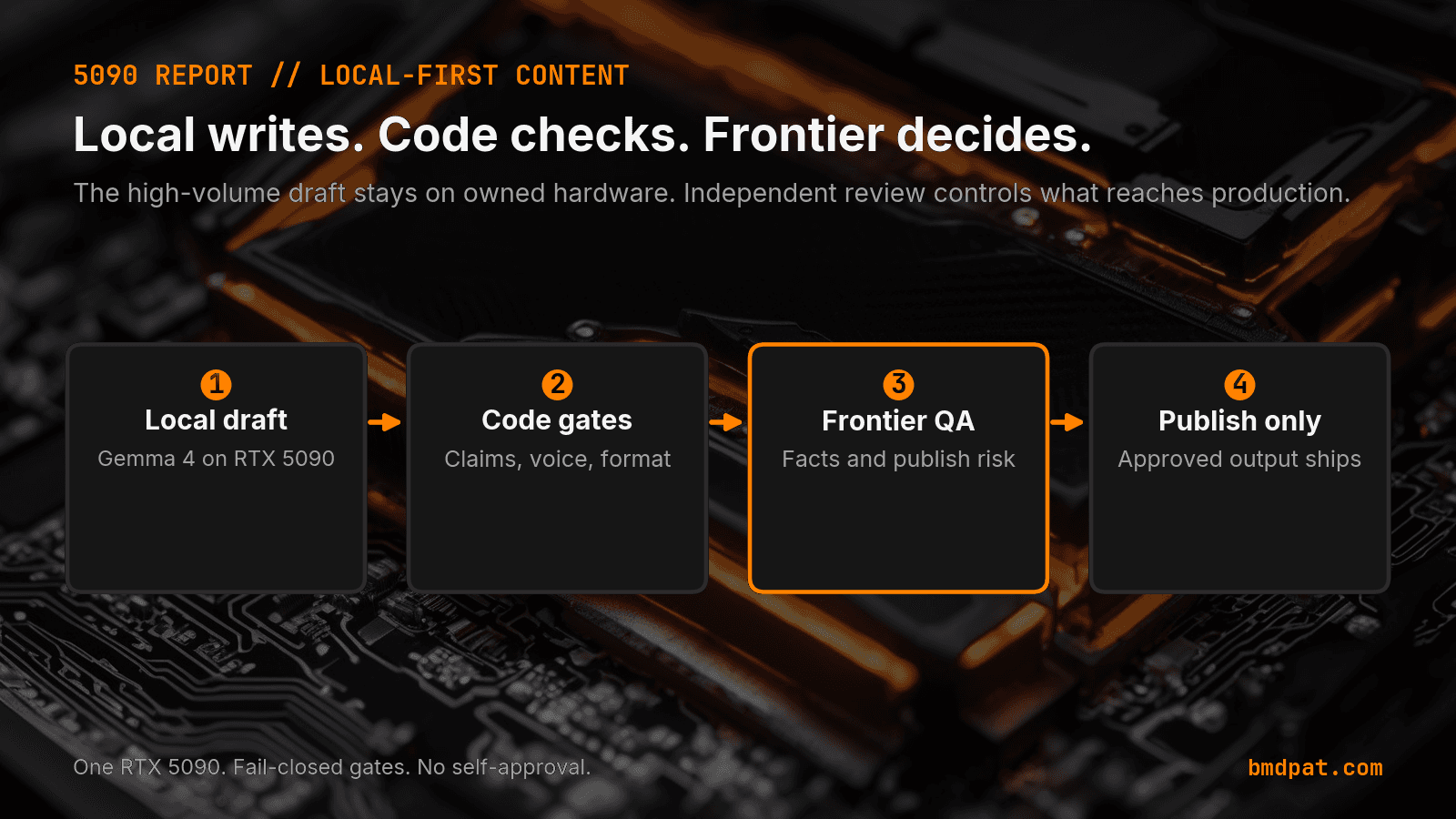
Gemma 4 26B wrote the draft through Ollama. The model was fully resident on the 5090. The accepted local generation took 6.2 seconds. Before the file entered review, code checked the metadata, post length, banned phrases, internal links, prompt block, CTA, and every percentage or dollar claim.
Then a separate frontier model reviewed the result. It rejected the first draft.
That rejection is the important part.
What did the local model get wrong?
The local draft had three real problems.
First, it split the digits in the 41% figure. Second, it omitted the closing line required by the reusable prompt block. Third, the source card did not contain the primary links needed to support its Vercel numbers, even though those numbers were in the writer's verified source pack.
The deterministic gate caught unsupported percentages in an earlier attempt. The frontier reviewer caught the corrupted number and the provenance gap in the accepted attempt. The repair script refused to make a subjective source decision and left the post blocked.
That is the behavior I want. Local generation can be cheap and fast because every later stage is allowed to say no.
Why move the writing pass to a 5090?
The economics now support this split outside my machine too.
Hugging Face reports that Chinese models accounted for 41% of model downloads on its platform. Vercel reports open-weight models handled 29% of AI Gateway tokens in June 2026 on under 4% of spend. Frontier labs still retained 95% of spend.
Those numbers do not say frontier models are obsolete. They say production volume and premium judgment are separating.
Writing a first draft is high-volume and reversible. Factual review is lower-volume and higher consequence. Running both steps on the most expensive model wastes the frontier budget on work my hardware can already do.
The same logic applies to classification, extraction, summaries, support drafts, and log analysis. Start with tasks where a bad local result can be rejected before a customer sees it.
For the machine details, read my 5090 local inference guide. For the budget side, see AI agent cost control.
Where should frontier models stay in the loop?
I am keeping frontier models on four jobs:
- Claim verification against primary sources.
- Voice review for public writing.
- Decisions where a false positive can publish, charge money, or change production state.
- Recovery when the local model fails the deterministic contract repeatedly.
I am moving routine drafting to the 5090. The local writer cannot approve its own work. It cannot publish. Its only output is a draft in a queue.
This boundary matters more than the model name. A local model with direct publish access is a bad design. A frontier model with direct publish access can still be a bad design. The controls need to live in code, not in a prompt asking the model to be careful.
What makes the pipeline permanent?
The old pipeline started at QA. If the morning digest created a content task but no draft, QA saw an empty folder and reported success. The publisher also saw an empty folder and reported success. Every process was green while the actual outcome was red.
The new chain starts earlier:
- The digest routes a source-backed content task.
- At 7:45 CT, Gemma 4 26B converts one eligible task into a draft.
- Code rejects malformed metadata, weak structure, unsafe language, and unsupported numeric claims.
- At 8:30 CT, an independent frontier provider reviews the surviving draft.
- The repair and publisher stages keep their existing gates.
- At 9:35 CT, the healer reruns the full chain and checks the live site.
Provider limits are scoped too. If the Claude subscription is exhausted, Claude is removed from the QA chain. That no longer disables Codex, Grok, or Gemini. Known Codex quota failures are skipped instead of consuming the whole review window.
The target is not zero frontier use. It is spending frontier attention where it changes the result.
Accompanying prompt
What the prompt does: This prompt helps you design a two-tier workflow where a local model generates content and a frontier model audits it for accuracy.
Copy/paste this prompt:
Copy-ready prompt
Paste the exact block into your coding agent.
No article chrome, no footnotes, no formatting drift.
This prompt and every other one we publish live in the free prompt library.
Copy the block above.
Weekly measured local runs: https://bmdpat.com/5090-reports
FAQ
What did the local writing pass get wrong?
It split the digits in the 41% figure, omitted the required closing prompt line, and lacked primary links for Vercel numbers even though those numbers were in the verified source pack.
Why move the writing pass to a 5090?
Writing a first draft is high-volume and reversible. Factual review is lower-volume and higher consequence. The accepted local generation took 6.2 seconds. Later stages are allowed to say no.
What public numbers support the open-weights shift?
Hugging Face: Chinese models were 41% of downloads. Vercel: open-weight models handled 29% of AI Gateway tokens in June 2026 on under 4% of spend, while frontier labs retained 95% of spend.
Get the Local AI Field Kit
Four copy-ready tools now, then one evidence-backed Local AI Lab Note on Friday when there is something worth sharing.
Try the free agent run check firstGet the requested artifact now, then at most one evidence-backed Local AI Lab Note on Friday when there is something worth sharing. One-click unsubscribe. No sponsored placements. Privacy.
Patrick Hughes
I build BMD and publish measured AI runs, failure reports, and reusable checks. Nashville, Tennessee.
More writing
- 5 min
Q4_K_M vs Q5_K_M (q4km vs q5km): Which to Download? (2026)
Stuck between q4km and q5km? Verdict: start with Q4_K_M on 8–24GB cards; move to Q5_K_M only if it still fits with KV-cache headroom. The 5-minute VRAM check inside.
- 5 min
q4km vs q4ks: which 4-bit file fits?
q4km is Q4_K_M and q4ks is Q4_K_S. For Llama 3.1 8B, the quantize README lists 4.36 GiB for Q4_K_S and 4.58 GiB for Q4_K_M.
- 5 min
KV Cache Q4 vs Q8 in llama.cpp Explained
Compare q4_0 and q8_0 KV cache options in llama.cpp server. Learn the exact CLI flags, allowed types, defaults, and how to verify output quality.
- 5 min
RFC 9110 402 Payment Required: Reserved for Future Use
RFC 9110 reserves status 402 for future use with zero wire protocol details. Check the IANA registry entry and handle custom payment headers in your client.
- 5 min
llama.cpp max context length gpu memory: What Fits
Find out how context length drives GPU memory in llama.cpp, how the KV cache scales, and which flags keep your local inference runs within VRAM limits.