Copilot vs Cursor vs Claude Code: 2026 Pricing Breakdown
The seat price isn't the real cost anymore. Real 2026 prices for GitHub Copilot, Cursor, and Claude Code, pulled from each vendor's own page.
TL;DR
- In 2026 Copilot, Cursor, and Claude Code all moved real spend onto usage. The monthly seat number is a floor, not a ceiling.
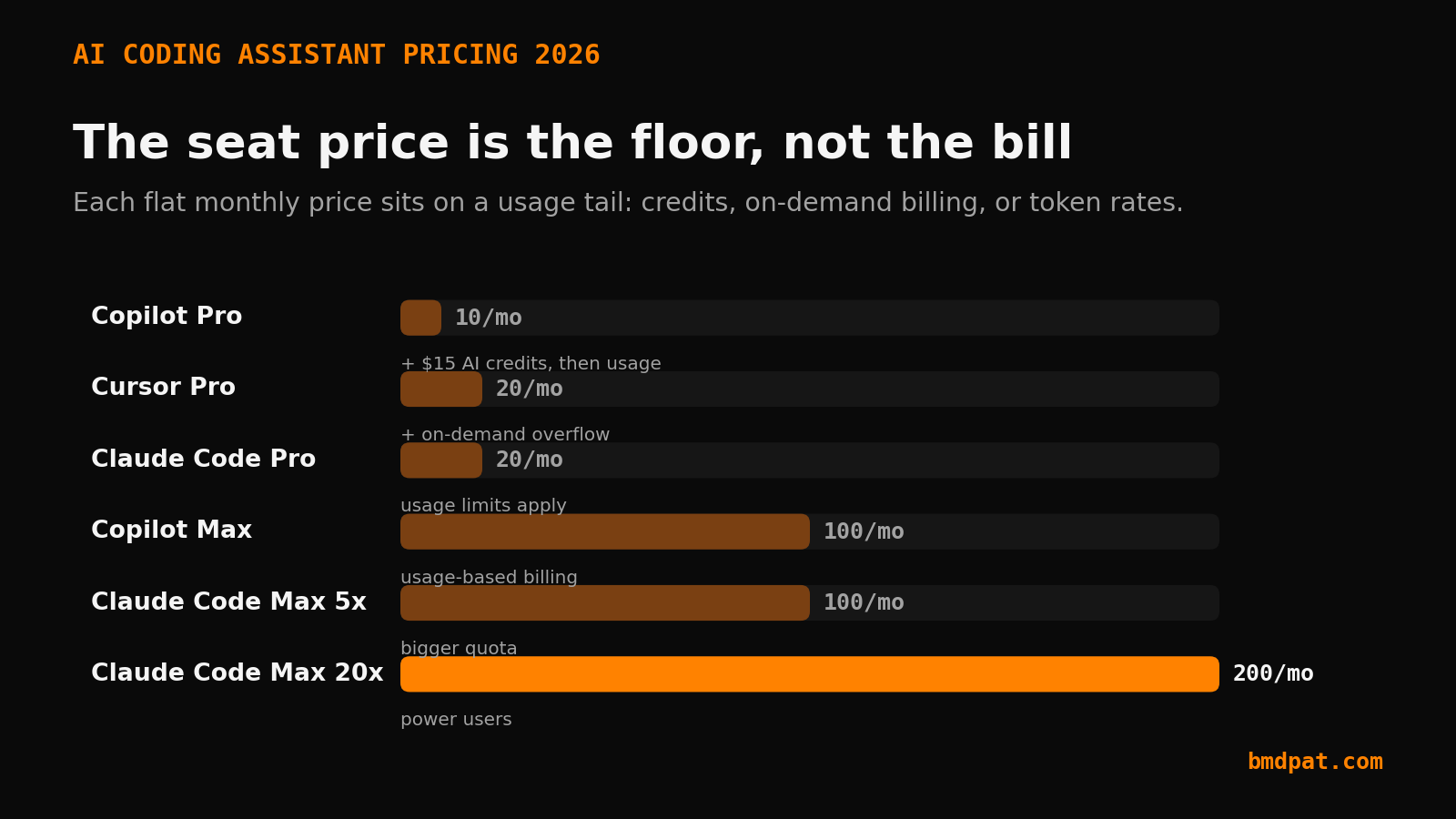
- Copilot Pro is $10 per month with $15 in monthly AI credits. Pro+ is $39 with $70 in credits. Max is $100 per month.
- Cursor Pro is $20 per month. Teams is $40 per user per month. Overflow is on-demand usage billed in arrears.
- Claude Code Pro is $17 per month on the annual plan or $20 billed monthly. Max 5x is $100. Max 20x is $200.
- A few heavy users on agent mode can move the bill more than adding five seats. Cap anything that calls a model in a loop.
Related guides
The sticker price on an AI coding tool stopped telling you what you will pay. In 2026 all three of the big ones moved real spend onto usage. The monthly seat number is now a floor, not a ceiling.
Here are the actual numbers, pulled from each vendor's own pricing page on June 12, 2026.
GitHub Copilot
Copilot is moving to usage-based billing. The seat tiers, from github.com/features/copilot/plans:
- Free
- Pro: $10 per month, with $15 in monthly AI credits
- Pro+: $39 per month, with $70 in monthly AI credits
- Max: $100 per month
Chat, agent mode, code review, the cloud agent, and the CLI all draw down GitHub AI Credits. When the included credits run out, you pay for more. GitHub even paused new Pro+ and Max sign-ups while it sorts out the billing change. The seat is cheap. The credits are the meter.
Cursor
Cursor keeps a simpler face on it, from cursor.com/pricing:
- Hobby: Free
- Pro: $20 per month
- Teams: $40 per user per month
- Enterprise: Custom
Every plan includes a set amount of model usage. Cursor calls the overflow on-demand usage, billed in arrears after you burn through what is included. Same shape as Copilot: a seat price plus a usage tail.
Claude Code
Claude Code rides on the Claude subscription, from anthropic.com/claude-code:
- Pro: $17 per month on the annual plan ($200 up front), or $20 billed monthly. Good for short sprints in small codebases.
- Max 5x: $100 per month
- Max 20x: $200 per month
You can also run it on a Team or Enterprise seat, or against an Anthropic Console account where you pay API rates per token. Usage limits apply on the subscription plans, so heavy days can still hit a wall.
Side by side
 Open full-size image (opens in new tab)
| Tool | Free | Entry | Power user | Team |
|---|---|---|---|---|
| GitHub Copilot | Yes | Pro $10/mo | Max $100/mo | usage-based |
| Cursor | Hobby | Pro $20/mo | on-demand | $40/user/mo |
| Claude Code | No | Pro $20/mo | Max 5x $100/mo | seat or Console |
Every cell above is a starting point. The real number rides on usage underneath it.
The pattern: seat price is a floor
Line them up and the story is the same across all three.
- Entry tier: Copilot $10, Cursor $20, Claude Code $17 on annual or $20 monthly
- Power tier: Copilot $100, Cursor on-demand, Claude Code $100 on Max 5x or $200 on Max 20x
Every plan now has a usage component underneath the flat fee. Credits, on-demand billing, token rates, usage caps. The flat monthly number is what you pay to walk in the door. What you actually owe depends on how hard your agents run.
That is the part teams miss. You budget for ten seats at $20 and forget that each seat has a usage tail that scales with how much the tool is used. A few heavy users on agent mode can move the bill more than adding five seats would.
What to do about it
Pick the tool on fit, not on the headline price, because the headline price is not the bill. Then watch usage like it is real money, because it is.
Two concrete moves:
- Track usage per developer, not just total seats. The spread between a light user and a heavy agent user is wide. You want to see it before the invoice does.
- Put a hard cap on anything that calls a model in a loop. Agent mode, cloud agents, and CLI runs are where a normal month turns into a surprise.
That second point is why I built AgentGuard. It is a runtime budget, token, and rate limiter for AI agents. You set a ceiling, and the agent stops at the ceiling instead of running your bill into a number you did not approve. The vendors are happy to meter you. AgentGuard is how you meter yourself first.
Prices change, and all three vendors say so plainly on their pages. The structure will not. Usage-based billing is the model now. Budget for the floor, plan for the tail, and cap the loops.
FAQ
What is the real cost of an AI coding assistant?
The seat price is only the visible part. Usage-based prompts, agent runs, retries, and background tasks can become the larger bill when coding agents run unattended.
How do you control AI coding assistant spend?
Track usage where model calls happen, keep PRs small, set runtime budgets, and stop retry loops before they turn one coding task into many paid calls.
Get the Local AI Field Kit
Four copy-ready tools now, then one evidence-backed Local AI Lab Note on Friday when there is something worth sharing.
Try the free agent run check firstGet the requested artifact now, then at most one evidence-backed Local AI Lab Note on Friday when there is something worth sharing. One-click unsubscribe. No sponsored placements. Privacy.
Written by
Patrick Hughes
I build BMD and publish measured AI runs, failure reports, and reusable checks. Nashville, Tennessee.
More writing
- 4 min
Agentic coding moved my bottleneck to code review
Agentic coding made writing code free. The slow part is now reviewing a queue of plausible PRs.
- 4 min
Missing AI agent cost data is not zero
A spend ledger that counts missing billing data as $0 hides exactly the unattended agent spend you built it to catch.
- 6 min
How to Close the AI Agent Cost Gap at the Call Site
The cost gap between what an AI agent could cost and what it does cost is 40%. You close it at the call site, not in a dashboard. Here is how.
- 4 min
When JPMorgan's AI bill goes up, who controls it?
JPMorgan turned on AI for 250k people. The quiet line is that the usage racks up fees. Here is how to control the bill before it arrives.
- 4 min
Anthropic Draft S-1: BudgetGuard and Goal Verification
Following Anthropic's draft S-1 filing, use BudgetGuard to check recorded API usage and verify task completion outcomes without guaranteed savings.