Why I Built a Paid GPU Check and Hid the Buy Button
On 2026-10-24, I shipped a paid GPU purchase review page with the payment link turned off. Here is why dead plumbing beats fake demand data.
I approved one fixed-price written service on 2026-10-24, merged the code, and deliberately left the payment link turned off. The page is /gpu-buy-check under bmdpat PR 2109, commit a57c3ba1. It is the only merge across seven repos on 2026-10-24.
Two private keys from an autotrader are still sitting in git history on day five. The security audit reported RED: 6 P0, 27 P1, and 48 P2 issues. A Raspberry Pi root disk hit 100% capacity with 0 bytes free because system journals filled 4.1 GB against a 4.0 GB limit. The automated think routine timed out at 600 seconds.
I still wrote the review page. Then I stopped the checkout from taking money.
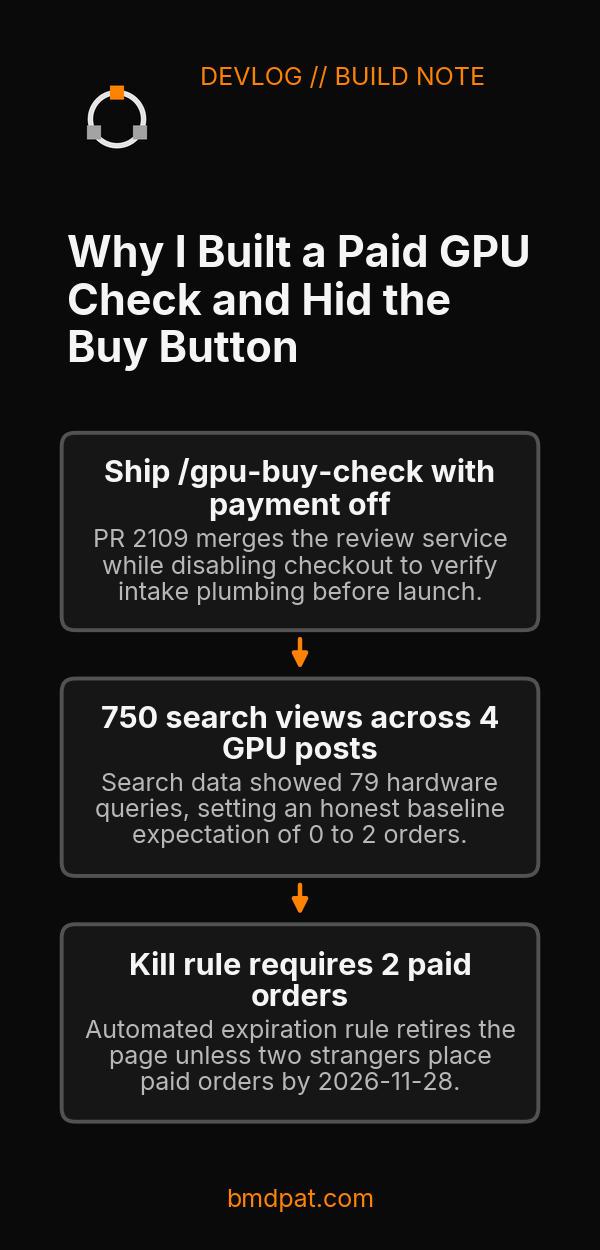 Open full-size image (opens in new tab)
Why ship a service page without a buy button?
A live checkout button over unverified intake plumbing masks your real demand numbers. If a form drops submissions or fails silently, you cannot tell whether visitors saw no value or hit broken software. Turning off the payment link forces you to verify page layout, traffic intent, and intake fields before claiming any conversion signal.
+------------------------------------+
| 750 Search Impressions             |
| 79 Hardware Query Terms            |
+-----------------+------------------+
                  |
                  v
+-----------------+------------------+
| 4 GPU Reference Posts              |
| Bridge line on 375, 768, 1440 px   |
+-----------------+------------------+
                  |
                  v
+-----------------+------------------+
| /gpu-buy-check Page (PR 2109)      |
| Payment link: OFF (No fake zeroes) |
+------------------------------------+
A search intent report showed 79 hardware queries and 750 impressions across four hardware articles. Readers search for specific cards, but free documentation never answers whether a specific card fits a specific budget.
If you run hardware workloads, you know that buying the wrong silicon wastes hundreds of dollars. Before checking any third-party listing, check your own model parameters against the 5090 local inference guide to see actual production throughput. Run your numbers through the VRAM calculator first. You can also read GGUF quantization explained to find out whether smaller weights meet your quality target.
The service draft lists its own historical failure modes right before the offer. Two prior asynchronous services sold zero units. With 750 impressions, standard click rates produce about 5 actual visits over 28 days. That means an honest baseline expectation is 0 to 2 total orders.
How do you kill an offer that fails?
You kill a failing offer by writing an automated expiration rule into your repo before launching. Commit 504924477a amends Rule 8 and creates gpu-buy-check-kill-rule-2026-11-28. It requires exactly two paid orders from strangers within 30 days to keep the page live.
| Project Metric | Value on 2026-10-24 | Target by 2026-11-28 | Rule Status |
|---|---|---|---|
| Paid Orders | 0 | 2 from strangers | Active |
| Search Impressions | 750 | Unspecified | Active |
| Target Repos Merged | 1 (PR 2109) | 7 repo sweep | In Progress |
| Pi Disk Space Free | 0 bytes | Greater than 1 GB | Failing |
Without an explicit rule, dead projects linger indefinitely on a website. Another service, Rig Fit, logged 16 views, 0 clicks, and 0 orders on 2026-10-24. A Python script at config/loops/rig_fit_verdict.py will record its verdict automatically on 2026-10-29. Unmeasured performance is never treated as a pass.
Across seven days ending 2026-10-24, user loops logged 1,471 human sessions, 30 clicks, and 0 install intents. In the last 24 hours of that window, the site saw 188 human sessions and 5 clicks. The numbers stay small, and hiding them solves nothing.
What should you do with this?
Audit your product pipeline for unverified claims, orphan projects, and hidden infrastructure failures.
- Check your primary server disks for runaway log files that exhaust available capacity.
- Search git commit histories for exposed authentication credentials and dependency CVEs.
- Attach an explicit expiration date and a minimum order count to every new service page.
The report told me where money sits and I priced exactly that, not a service menu.
Accompanying prompt
What the prompt does: Evaluates hardware upgrade requirements against specific target model parameters and constraints before buying hardware.
Copy/paste this prompt:
Copy-ready prompt
Paste the exact block into your coding agent.
No article chrome, no footnotes, no formatting drift.
This prompt and every other one we publish live in the free prompt library.
Copy the block above.
Weekly measured local runs: https://bmdpat.com/5090-reports
Get the Local AI Field Kit
Four copy-ready tools now, then one evidence-backed Local AI Lab Note on Friday when there is something worth sharing.
Try the free agent run check firstGet the requested artifact now, then at most one evidence-backed Local AI Lab Note on Friday when there is something worth sharing. One-click unsubscribe. No sponsored placements. Privacy.
Written by
Patrick Hughes
I build BMD and publish measured AI runs, failure reports, and reusable checks. Nashville, Tennessee.
More writing
- 5 min
OpenClaw AI Assistant Latest News 2026
OpenClaw release v2026.10.4 repairs sleep restarts and Tlon permissions, following skill discovery, MCP Apps, and R2 backup updates in October 2026.
- 5 min
I Rebuilt BMD Desktop Around Queues and Drain
On 2026-10-14, I rebuilt BMD Desktop around queues, cut 63 open requests down to 10, and faced an overnight log full of red security audits.
- 5 min
Twelve Characters Put My Government Page Live
On 2026-10-03, CI stalled on full disks before a twelve-character string cleared production. Here is how I removed myself from the merge loop.
- 5 min
Horizon Closed Seven Red, Three Amber, Zero Green
On 2026-10-15, my 90-day horizon closed red across seven bets. Here is what broke in my fleet, what shipped, and how to audit your checks.
- 5 min
A Sandbox Split Stopped My Fleet While 142 Tests Cleared
On 2026-10-09 my nightly sweep aborted on sandbox branch drift. A green scan checked zero repos. Here is how 142 CI admission tests still cleared.