I built refusals into my claim recorder
On September 23, I added write-time checks to my agent claim recorder. Six bad rows needed retraction. Here is what those checks can and cannot prove.
I added write-time refusals to my claim recorder on September 23, 2026. Six bad rows needed retraction.
The recorder now rejects malformed checks before accepting a claim. That makes the stored record easier to verify, but it cannot establish that the claimed work happened. A valid check still has to run and cover the result it names.
Canonical URL: https://bmdpat.com/blog/i-built-refusals-into-my-agent-s-data-recorder-2026
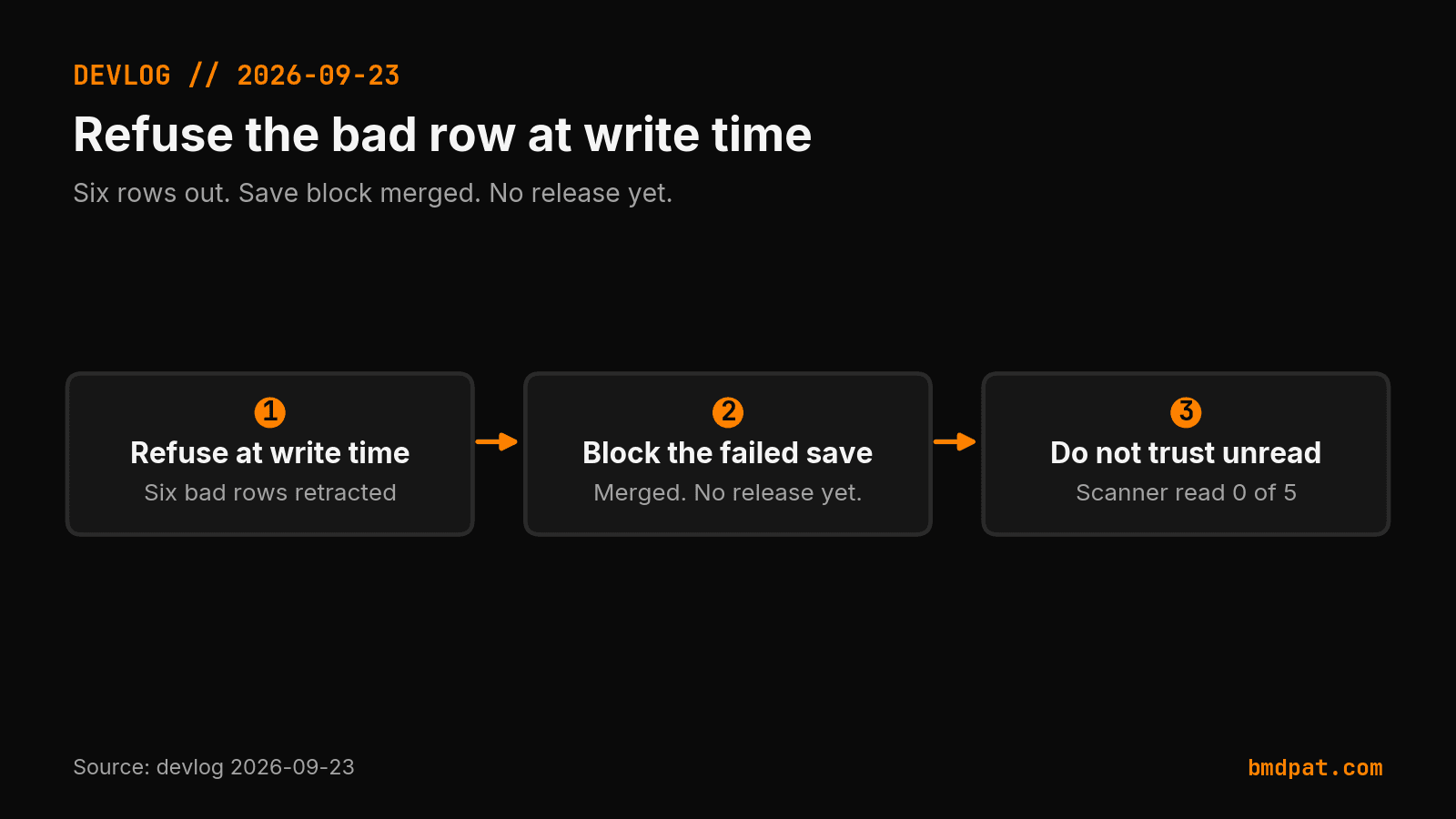
What did I change in the recorder?
I moved the malformed-check rejection to write time. My September 23 devlog records the change and six retracted rows. Those are separate actions: refusing a new bad row does not remove an older one.
The scheduled prompt changed too. run-agent.ps1 now appends the recorder command to every scheduled prompt. The devlog records 11 tests for that change. Those tests cover command flags, session naming, prompt insertion, and running the example through the recorder.
Which input does the recorder reject?
A file_contains check needs type, path, and pattern. The pattern is a regular expression. The September 23 regression involved a text key where the checker expected pattern. Changing the field name changes whether the checker can read the assertion.
I replayed that field mismatch through shape_refusal on September 24. This is the actual input and output, with an illustrative filename:
bad = {"type": "file_contains", "path": "report.md", "text": "PASS"}
print(shape_refusal(bad))
refusing a claim whose check can never verify: file_contains needs a non-empty `pattern` (a regex); the check has `text`, which the grammar does not read (rename it to `pattern`).
  check as this process received it: {'type': 'file_contains', 'path': 'report.md', 'text': 'PASS'}
  The grammar is config/claims/check.py (see config/claims/README.md).
The corrected shape returns None, meaning no shape refusal:
good = {"type": "file_contains", "path": "report.md", "pattern": "PASS"}
print(shape_refusal(good))
That call checks the definition. It does not read report.md. The full recorder also evaluates supported content checks at write time. The reproduction above tests only shape refusal, so I cannot use it to claim that a report contains PASS.
What does a valid claim still need?
A valid claim needs evidence that matches its wording. A check that a file exists can support an existence claim. It cannot, on its own, support a claim that the file contains a correct answer. The difference matters before you store the result.
The report can exist, open, and look finished while leaving the question unanswered. I described that distinction in checking the result beyond its schema.
I would narrow the claim to what the check covers. If I need the broader claim, I need a different check.
What happened to the six old rows?
The six bad rows were retracted, according to the September 23 devlog. The new refusal protects later writes. Retraction deals with claims already in the record. I need both, because changing the recorder does not establish the truth of its history.
That distinction also changes how I read a summary. If an earlier row claimed completion, a later correction has to travel with it. Otherwise the next agent can inherit the old answer after the underlying record has changed.
Keeping evidence in files gives me something I can reopen. It also leaves me responsible for reading the corrections. Writing agent memory to files gives the record a location. It does not make every sentence current.
What did the day's scan fail to establish?
The September 23 devlog recorded a green security summary beside a scan that read zero of five repos. The coverage count was enough to reject a clean-scan conclusion. It said nothing about what a completed scan would find.
This is why I keep the claim and its scope together. A malformed-check refusal addresses input shape. A coverage count addresses what was examined. A result check addresses what happened. Passing one leaves the others open.
The day's evidence stops there: write-time refusals, six retractions, and a scheduled-prompt change with 11 tests. I have no before-and-after count showing fewer bad claims across later runs. That outcome remains unmeasured.
Accompanying prompt
What the prompt does: It reviews whether one agent claim has enough evidence, without treating a well-formed row as proof of completion.
Copy/paste this prompt:
Copy-ready prompt
Paste the exact block into your coding agent.
No article chrome, no footnotes, no formatting drift.
This prompt and every other one we publish live in the free prompt library.
Copy the block above.
Get the Local AI Field Kit
Four copy-ready tools now, then one evidence-backed Local AI Lab Note on Friday when there is something worth sharing.
Try the free agent run check firstGet the requested artifact now, then at most one evidence-backed Local AI Lab Note on Friday when there is something worth sharing. One-click unsubscribe. No sponsored placements. Privacy.
Patrick Hughes
I build BMD and publish measured AI runs, failure reports, and reusable checks. Nashville, Tennessee.
More writing
- 5 min
Ten Merges, One Dead Disk, Four Fake Green Signals
On 2026-09-19 I merged ten PRs into BMD desktop while a dead disk faked four green signals across the fleet. Here is what broke and what shipped.
- 5 min
I dropped the BMD kill date and named it flagship
On 2026-09-21, I removed the October 1st kill date for BMD. I also shipped bmd-desktop 3.47.15 and fixed a clipboard bug in bmdpat.
- 4 min
My sandbox passed two tests. The full run was unproven.
I repaired a Windows agent launcher on September 17. Shell commands and two tests passed. That still did not prove the whole nightly queue could finish.
- 5 min
Gemini first for four jobs. One run finished two tasks.
I moved four recurring jobs to Gemini, then checked what actually finished. One recorded run proved progress. The broken queue sweep stayed broken.
- 4 min
My agent roadmaps did not prove the work was done
I wrote agent roadmaps, but my September 18 records showed a separate problem. Plans, delivered work, and saved time each need their own evidence.