LM Studio Bionic: The Local Open-Model Agent, Explained (2026)
Is LM Studio Bionic worth a look? It runs code projects on a local folder with GLM 5.2 and Kimi K2.7 Code, local voice via Voxtral, and is free with local models. What shipped, and what it changes.
TL;DR
- LM Studio shipped Bionic in July 2026, its first purpose-built AI agent, on Mac and Windows. It runs code projects against a local folder using open models like GLM 5.2 and Kimi K2.7 Code.
- It does document work across PDFs, decks, and spreadsheets, and ships a voice keyboard with local transcription via Voxtral from Mistral AI. Demanding work can route to larger open models through LM Studio Secure Cloud under a zero data retention policy.
- It is free with local models. The cloud tier takes credits. There is no frontier closed model in that stack. The cloud tier is open models too, just bigger ones on someone else's hardware.
 Open full-size image (opens in new tab)
Summary: LM Studio shipped Bionic in July 2026, its first purpose-built AI agent, on Mac and Windows. It runs code projects against a local folder using open models like GLM 5.2 and Kimi K2.7 Code, does document work across PDFs, decks, and spreadsheets, and ships a voice keyboard with local transcription via Voxtral from Mistral AI. It routes demanding work to larger open models through LM Studio Secure Cloud under a zero data retention policy. It is free with local models. The cloud tier takes credits.
LM Studio used to be a runtime and a chat window. Now it is an agent. That change is worth more attention than the feature list.
What actually shipped?
Four things, and the shape of them matters more than any one feature.
Code projects against a local folder. You point Bionic at a directory and ask an open model to investigate, edit, or debug it, watching the work as it goes. This is the agentic coding loop, running on weights you can hold, over files that never move.
Document work. PDFs, decks, spreadsheets. Not code, which is the point. The local agent is being pitched at knowledge work, not just at developers.
Local voice. A voice keyboard with transcription running locally via Voxtral. Speech has been the most obviously cloud-shaped part of the stack for years. Putting it on-device by default is a statement about where they think the floor is now.
Optional cloud routing. Bigger open models available through their Secure Cloud for demanding reasoning, tool-calling, and long-context tasks, with a zero data retention policy on those requests.
Notice what is missing from that list. There is no frontier closed model anywhere in it. The cloud tier is open models too, just bigger ones on someone else's hardware.
Why does this matter more than another app launch?
Because of who built it and what they had to believe to build it.
LM Studio's existing users are people who already chose to run models locally. Shipping a full agent for that audience is a bet that local users now want long-running autonomous work, not just private chat. That is a different product and a much harder one. Chat forgives a slow or mediocre model. An agent chaining twelve tool calls does not.
Building it anyway means they think open-weight models on consumer hardware are now good enough to sustain an agent loop. Two years ago that would have been a stretch. The fact that it is a shipping consumer product, on Mac and Windows, free at the local tier, says the capability floor moved.
The second signal is the pricing shape. Free with local models, credits for cloud. That prices exactly the thing that costs money and gives away the thing that does not. It is an honest structure, and it quietly teaches users the real economics: inference on your own machine has no per-token bill, and inference on someone else's does.
Is the category real or is this one product?
It is a category. Bionic is the packaging, not the origin.
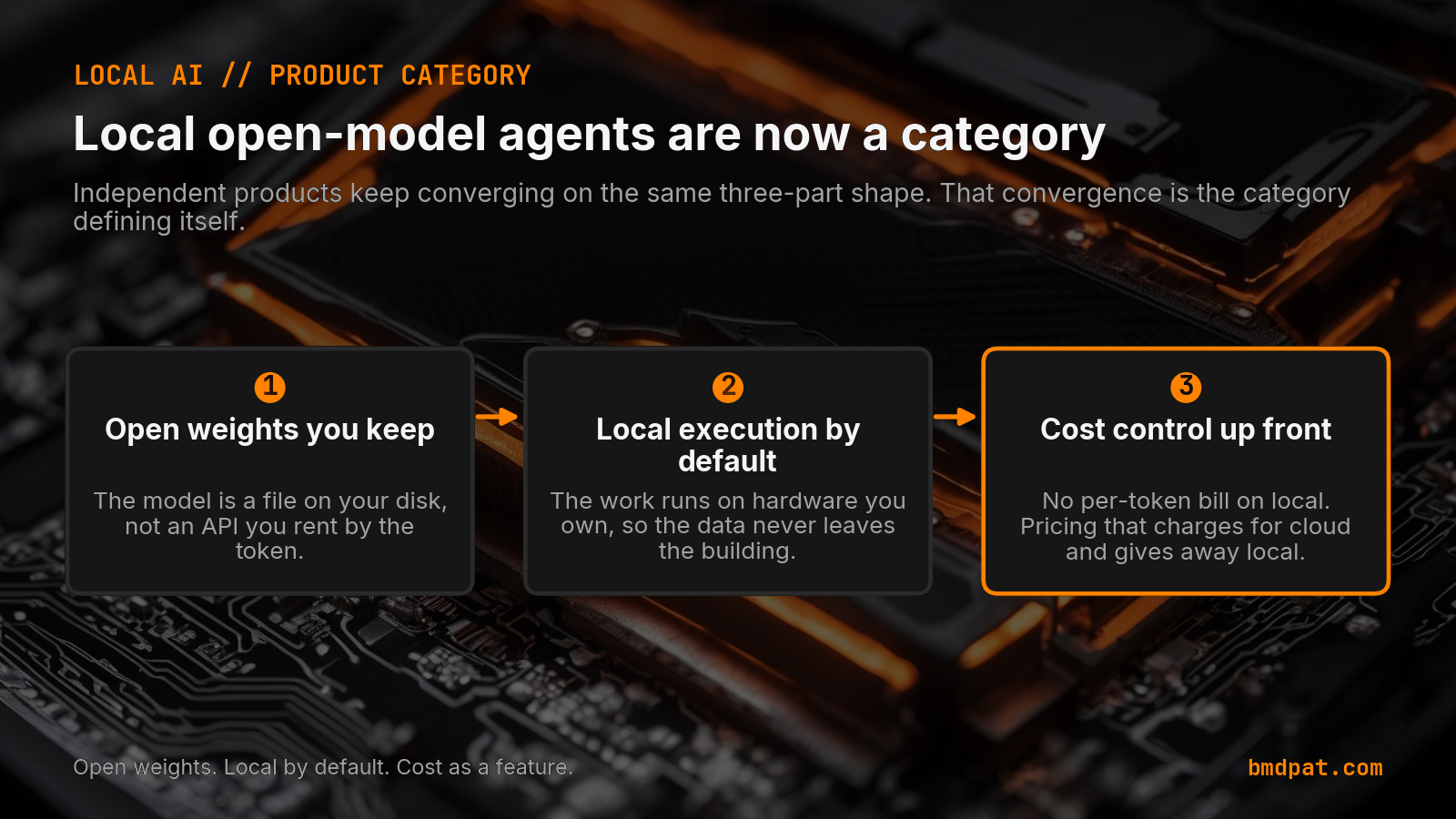
The pattern showing up across every one of these products is the same three-part pitch. Open weights, so the model is a file you keep. Local execution by default, so the data does not move. Cost control as a headline feature rather than a footnote. Privacy claims like zero data retention have gone from differentiator to table stakes, which is what happens when a category matures.
The feature set is converging too. Local voice plus code projects over local folders is becoming the default shape of a local agent in 2026, the same way tabs and extensions became the default shape of a browser. When independent products converge on the same feature set, that is the category defining itself.
What does this change for people running their own fleets?
Less than you would think, and that is the useful part.
A packaged agent app is a great on-ramp. It is not a fleet. The gap between "I can run an agent on my machine" and "I run twenty scheduled agents unattended" is not model capability. It is operations. Scheduling, retries, state, logging, and the question of what happens when something loops forever at 3am.
That last one is where packaged apps and self-run fleets diverge hardest. An interactive agent has a human watching it. You see the loop spin and you stop it. A scheduled agent has nobody watching, which is the entire reason you scheduled it.
Local makes this trap easier to fall into, not harder. When there is no per-token bill, the feedback signal that would have caught a runaway loop is gone. No invoice, no alert, no rate limit from a provider. Just a card at full draw all night producing garbage, and you find out in the morning. The cost is real. It is denominated in electricity, hardware wear, and the work that job was supposed to have finished.
So the discipline that matters is the same one that mattered when the tokens were metered. Every unattended loop gets a token ceiling and a wall-clock limit sized to what the job should cost when behaving. Exceeding it should stop the run and produce an error you will see, not a quiet truncation that makes the output subtly wrong.
What should you actually take from this?
If you are curious about local agents, the on-ramp got much shorter. You do not need to wire a runtime, a model server, and a tool loop together to find out whether open models can do your work. Install a packaged agent, point it at a real folder, and give it a real task. You will learn more in an afternoon than from a month of benchmark reading.
Test with your actual work, not a demo. The honest limits of local models show up on hard multi-step reasoning and very long context, and they show up fast. Better to meet those limits on a task you understand than to find them later on something that matters.
Keep frontier models for what needs them. The useful split has not changed. High-volume, repetitive, or sensitive work runs local, where the meter is off and the data stays put. Hard reasoning over public data goes to the frontier model. Most real workflows need both.
Put a ceiling on anything that runs unattended. Whether the tokens cost money or electricity, a loop with no stop condition is the same failure.
That last one is what AgentGuard is for. Runtime budget, token, and rate limits for agent loops, local or hosted. pip install agentguard47, import it as agentguard, set the cap once.
The category arriving is good news. It means the models are good enough that the interesting problems moved from capability to operations. Operations is a solvable problem, as long as you actually solve it.
Accompanying prompt
What the prompt does: Routes a task to a local open model or a frontier model using the split this post argues for. Describe the task and it returns a recommendation with the reasoning, so you stop sending sensitive or high-volume work to a metered API by default.
Copy/paste this prompt:
Copy-ready prompt
Paste the exact block into your coding agent.
No article chrome, no footnotes, no formatting drift.
This prompt and every other one we publish live in the free prompt library.
Copy the block above.
Get the artifact-backed local AI lab notes by email: https://bmdpat.com/5090-reports
Related reading
FAQ
What is LM Studio Bionic?
A purpose-built AI agent shipped in July 2026 on Mac and Windows. It runs local code projects, document work, and local voice transcription via Voxtral, with optional Secure Cloud routing to larger open models.
What models does Bionic use?
Open models such as GLM 5.2 and Kimi K2.7 Code locally. Optional cloud routing uses larger open models, not a frontier closed model, under a zero data retention policy.
How is Bionic priced?
Free with local models. The cloud tier takes credits. Inference on your own machine has no per-token bill. Inference on someone else's does.
Get the Local AI Field Kit
Four copy-ready tools now, then one evidence-backed Local AI Lab Note on Friday when there is something worth sharing.
Try the free agent run check firstGet the requested artifact now, then at most one evidence-backed Local AI Lab Note on Friday when there is something worth sharing. One-click unsubscribe. No sponsored placements. Privacy.
Written by
Patrick Hughes
I build BMD and publish measured AI runs, failure reports, and reusable checks. Nashville, Tennessee.
More writing
- 6 min
Incident response needs a local model you already trust
Hugging Face ran its breach forensics on an open-weight model on its own hardware because hosted APIs refused the requests. Here is the lesson for builders.
- 5 min
Your local LLM is not a worse Claude. It is a different tool.
Stop scoring your local model on how close it gets to Opus. It is a different tool with a different sweet spot. Here is the line, and which side your work sits on.
- 5 min
I Rebuilt BMD Desktop Around Queues and Drain
On 2026-10-14, I rebuilt BMD Desktop around queues, cut 63 open requests down to 10, and faced an overnight log full of red security audits.
- 5 min
Twelve Characters Put My Government Page Live
On 2026-10-03, CI stalled on full disks before a twelve-character string cleared production. Here is how I removed myself from the merge loop.
- 5 min
Horizon Closed Seven Red, Three Amber, Zero Green
On 2026-10-15, my 90-day horizon closed red across seven bets. Here is what broke in my fleet, what shipped, and how to audit your checks.