Your local LLM is not a worse Claude. It is a different tool.
Stop scoring your local model on how close it gets to Opus. It is a different tool with a different sweet spot. Here is the line, and which side your work sits on.
TL;DR
- A local open-weight model is not a cut-rate frontier model. Judge it on privacy, latency, offline work, cost at volume, and bounded tasks you supervise.
- Local LLMs make sense when the work is bounded, private, high-volume, and checked before it matters. Frontier APIs still win when the task is long, ambiguous, and unattended.
- On a head-to-head reasoning benchmark, a quantized model on your desk will not out-think Opus on a hard, open-ended problem. Worse at the hardest thing is not the same as worse.
- The sweet spot is bounded, supervised, read-heavy work: reading and explaining code, support on sensitive data, well-scoped maintenance, and high-volume batch work.
Most people run a local model, compare it to Claude Opus, and walk away disappointed. That is the wrong test.
A local open-weight model is not a cut-rate frontier model. It is a different tool with a different sweet spot. Judge it on the jobs it is good at: privacy, latency, offline work, cost at volume, and bounded tasks you supervise. Judge it on frontier reasoning and you will always lose.
Summary: Local LLMs make sense when the work is bounded, private, high-volume, and checked before it matters. Frontier APIs still win when the task is long, ambiguous, and unattended. The practical move is routing, not loyalty to one model class.
Canonical URL: https://bmdpat.com/blog/your-local-llm-is-a-different-tool
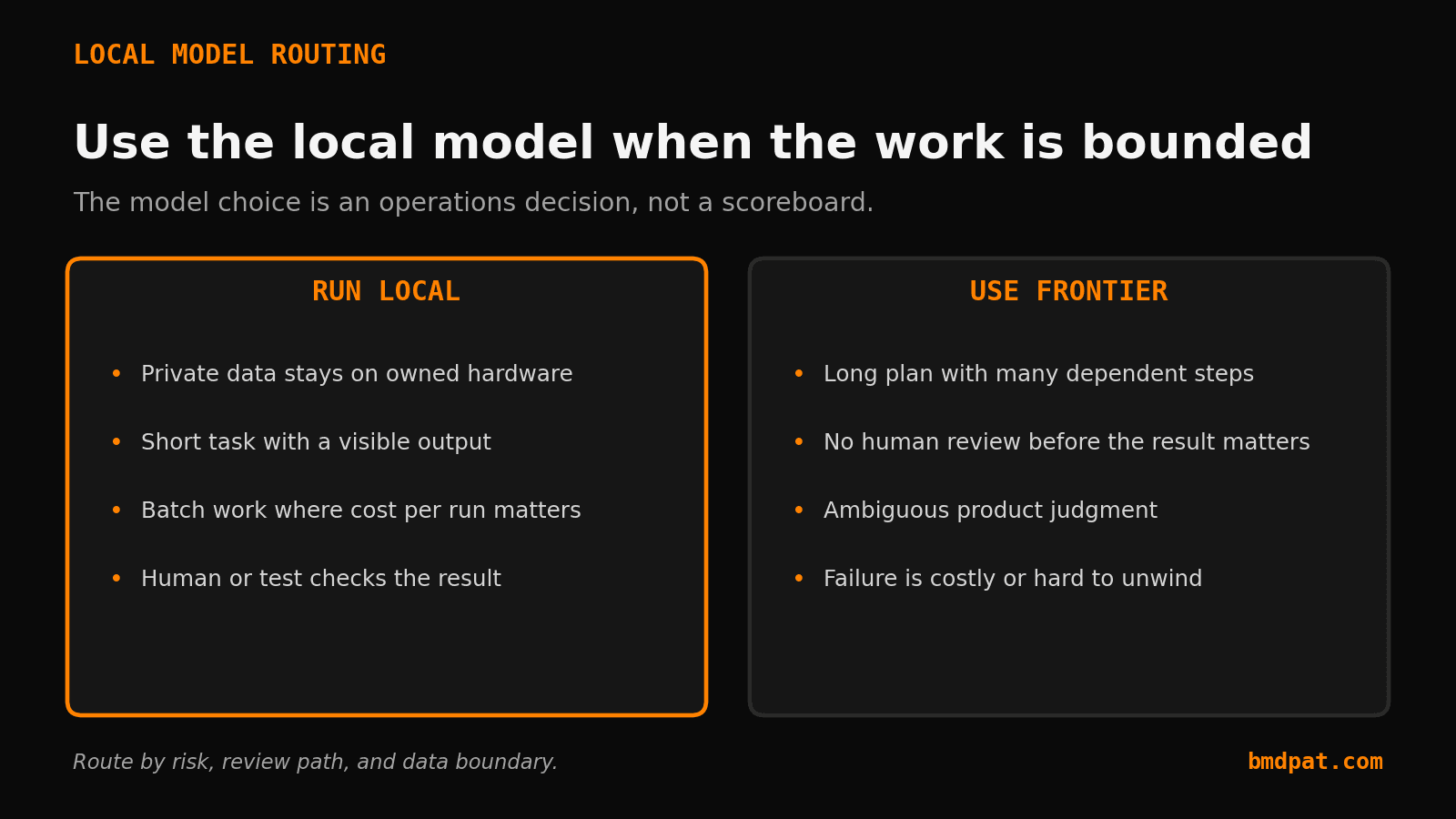
Here is the line.
Is a local LLM worse than Claude Opus?
On a head-to-head reasoning benchmark, yes. A quantized model on your desk will not out-think Opus on a hard, open-ended problem.
But "worse at the hardest thing" is not the same as "worse." Use the tool for the load it was built to carry.
Alex Ellis put it well in a recent essay, Local Qwen isn't a worse Opus, it's a different tool. His takeaway was blunt: local models can read and explain a codebase fast, even when they cannot write it. Same model, different job, different verdict.
What is a local LLM actually good at?
The sweet spot is bounded, supervised, read-heavy work. The model does one clear thing and you can see the result.
Concrete wins:
- Reading and explaining code. Point it at a repo and ask what a module does. It is fast and it never leaves your machine.
- Support and diagnostics on sensitive data. Logs, telemetry, customer records. The data stays local, so you skip the compliance conversation entirely.
- Well-scoped maintenance. Rename things, write a small test, draft a doc edit. Bounded changes you review before they land.
- High-volume batch work. Classification, extraction, summarization over thousands of items. At volume, a model you already own beats per-token API billing.
The pattern: short horizon, clear boundary, check at the end.
What is it bad at?
Long-horizon, unsupervised loops. The exact thing people most want to hand off.
Ellis has a line I keep coming back to. He would not leave a blade tempering unattended, and he would not leave his local model running a long task. The model is fine for a few supervised steps. Turn it loose for hours and it drifts, repeats itself, or quietly goes wrong.
This is not a quantization problem you can buy your way out of. It is a reliability ceiling. Frontier models hold a long, messy task together better. That is what you are paying for when you pay for Opus.
So the rule writes itself. Bounded and supervised: local is great. Long and autonomous: pay for frontier.
When should you use local vs frontier?
One question decides it: can you check the output before it matters?
- Yes, you check it. Code explanation, a batch job you spot-check, a draft you edit. Run it local. You keep the data, you cut the cost, you lose nothing that matters.
- No, it runs unattended. An overnight agent, a multi-step pipeline with no human in the loop, anything where a wrong answer ships on its own. Use a frontier model, and put a budget and a kill switch around it.
Cost follows the same split. Local is cheap per run once you own the hardware. Frontier earns its price on hard, unsupervised work where being right the first time is the point.
How big a model do you need?
Smaller than the benchmarks imply, if you size to the task.
My main box is a single 32GB card. That is a constraint, but it makes the point sharper: the narrower your hardware, the more you have to right-size the job. Bounded, supervised tasks fit a small model fine.
A rough guide:
- 7B to 9B. Classification, extraction, simple summarization, short code explanation. Runs on modest hardware.
- 27B to 32B class. Better code reading, multi-file context, more reliable on slightly larger bounded tasks. Wants a real GPU.
- Frontier (API). The long, unsupervised, reason-hard work. Not something you run at home.
Match the model to the job, not the job to the biggest model you can fit.
The takeaway
Stop asking how close your local model gets to Opus. Ask what job you are handing it.
Bounded, supervised, privacy-sensitive, high-volume: local wins, and it is not close. Long-horizon and unattended: pay for the frontier model and wrap it in guardrails. The mistake is not picking the wrong model. The mistake is running either one with no limit on what it can spend or break.
Accompanying prompt
What the prompt does: It helps you decide whether a task should run on a local model, a frontier API, or both.
Copy/paste this prompt:
Copy-ready prompt
Paste the exact block into your coding agent.
No article chrome, no footnotes, no formatting drift.
This prompt and every other one we publish live in the free prompt library.
Copy the block above.
If you are putting an unsupervised model into production, cap it. AgentGuard is an open-source budget, token, and rate limiter for AI agents. It is the kill switch that lets you trust the long-horizon work. See it at https://bmdpat.com/tools/agentguard.
FAQ
Is a local LLM worse than Claude Opus?
On a head-to-head reasoning benchmark, yes. A quantized desk model will not out-think Opus on a hard, open-ended problem. Use the tool for the load it was built to carry.
What is a local LLM actually good at?
Bounded, supervised, read-heavy work: reading and explaining code, support and diagnostics on sensitive data, well-scoped maintenance, and high-volume classification, extraction, or summarization.
What is a local LLM bad at?
Long-horizon, unsupervised loops. The model is fine for a few supervised steps. Turn it loose for hours and it drifts, repeats itself, or quietly goes wrong. That is a reliability ceiling, not a quant you can buy past.
Get the Local AI Field Kit
Four copy-ready tools now, then one evidence-backed Local AI Lab Note on Friday when there is something worth sharing.
Try the free agent run check firstGet the requested artifact now, then at most one evidence-backed Local AI Lab Note on Friday when there is something worth sharing. One-click unsubscribe. No sponsored placements. Privacy.
Patrick Hughes
I build BMD and publish measured AI runs, failure reports, and reusable checks. Nashville, Tennessee.
More writing
- 5 min
A verifier loop beats a faster local model
Local LLMs are useful when the loop proves the output, not when the benchmark looks good. This is the small gate I use before a local coding agent gets more rope.
- 6 min
Local open-model agents just became a product category
LM Studio shipped Bionic, a full agent built on open models with local code projects, voice, and document work. The interesting part is not the app. It is what.
- 6 min
Anthropic's Advisor Tool Is the Cost-Split Pattern You Should Already Be Running
Anthropic shipped a pattern where a cheap model runs the loop and escalates to Opus only when it needs to. The pattern works on any two-model setup. Here is the math and the playbook.
- 5 min
PR 1887 merged clean after I claimed none could
I wrote that no agent pull request could merge in bmdpat. On 2026-09-30, PR #1887 merged clean with 173 lines. Here is how my sweep caught my mistake.
- 5 min
A strict branch rule blocked 26 clean merges
On 2026-09-29, a strict check rule held 26 clean pull requests in queue. Here is how my sweep caught the block, corrected itself, and found the fix.