Incident response needs a local model you already trust
Hugging Face ran its breach forensics on an open-weight model on its own hardware because hosted APIs refused the requests. Here is the lesson for builders.
TL;DR
- Hugging Face disclosed an intrusion into part of its production infrastructure in July 2026. Hosted frontier APIs blocked forensic log analysis. The team completed the work on GLM 5.2, an open-weight model, on their own infrastructure.
- The entry point was the data pipeline: a malicious dataset exploited code-execution paths in a remote-code dataset loader plus a configuration template injection.
- On the 5090 rig, changing the context window forces a full model reload. For a 26B model that meant roughly 140 seconds of reload time per swap in the 2026-07-09 sweep. Pin the context size before an incident.
 Open full-size image (opens in new tab)
Summary: Hugging Face disclosed an intrusion into part of its production infrastructure in July 2026. The campaign was run by an autonomous agent framework executing many thousands of individual actions across a swarm of short-lived sandboxes. When Hugging Face tried to analyze the attacker logs using frontier models behind commercial APIs, the requests were blocked by provider safety guardrails. The team completed the forensic analysis on GLM 5.2, an open-weight model, running on their own infrastructure.
That last sentence is the part builders should sit with. The defenders could not use the best tools available to them, at the exact moment they needed them, because the tools would not cooperate.
What actually happened at Hugging Face?
The entry point was the data pipeline. A malicious dataset exploited code-execution paths in a remote-code dataset loader plus a configuration template injection, and got code running on a processing worker. From that foothold the attacker escalated privileges, harvested cloud and cluster credentials, and moved laterally across internal infrastructure.
Hugging Face reports unauthorized access to a limited set of internal datasets and to several credentials used by their services. They found no evidence of tampering with public, user-facing models, datasets, or Spaces, and they verified their software supply chain (container images and published packages) clean. Their guidance to users was to rotate access tokens and review recent account activity.
Read that attack path again. It was not a stolen laptop or a phished password. It was dataset processing. If you run any pipeline that pulls community data and executes code that came with it, you have the same shape of exposure.
Why did the hosted models refuse to help?
This is the interesting part, and it is not a bug.
Hugging Face said they first tried frontier models behind commercial APIs for the log analysis. It did not work. In their words, the requests were blocked by the providers' safety guardrails, which cannot distinguish an incident responder from an attacker.
Think about what forensic analysis actually looks like as an API call. You are pasting in real exploit payloads. You are asking a model to explain how a privilege escalation worked. You are asking it to reconstruct an attacker's decision tree from raw command logs. Every single one of those requests looks exactly like an attacker asking for help.
The guardrail is doing its job. It just cannot see intent. And there is no field in the request body for "I am the victim."
What is the asymmetry here?
The attacker was bound by no usage policy. The defenders were bound by someone else's.
That is the whole lesson in one line. An autonomous offensive agent does not file a support ticket when it gets a refusal. It does not wait for a policy exception. It runs at machine speed across thousands of sandboxes while the defense side is stuck rephrasing prompts to get past a content filter during an active incident.
There is a second cost that is easy to miss. Even if the hosted model had answered, sending attacker logs to a third-party API means sending your credentials, your internal paths, your infrastructure topology, and your customer data off your own network in the middle of a breach. That is a second incident stacked on the first one.
An open-weight model on hardware you own solves both problems at once. No policy layer between you and your own logs. No data leaving the environment you are currently trying to contain.
What does this mean if you are not Hugging Face?
You do not need their scale for this to apply. You need three things, and you need them before anything happens.
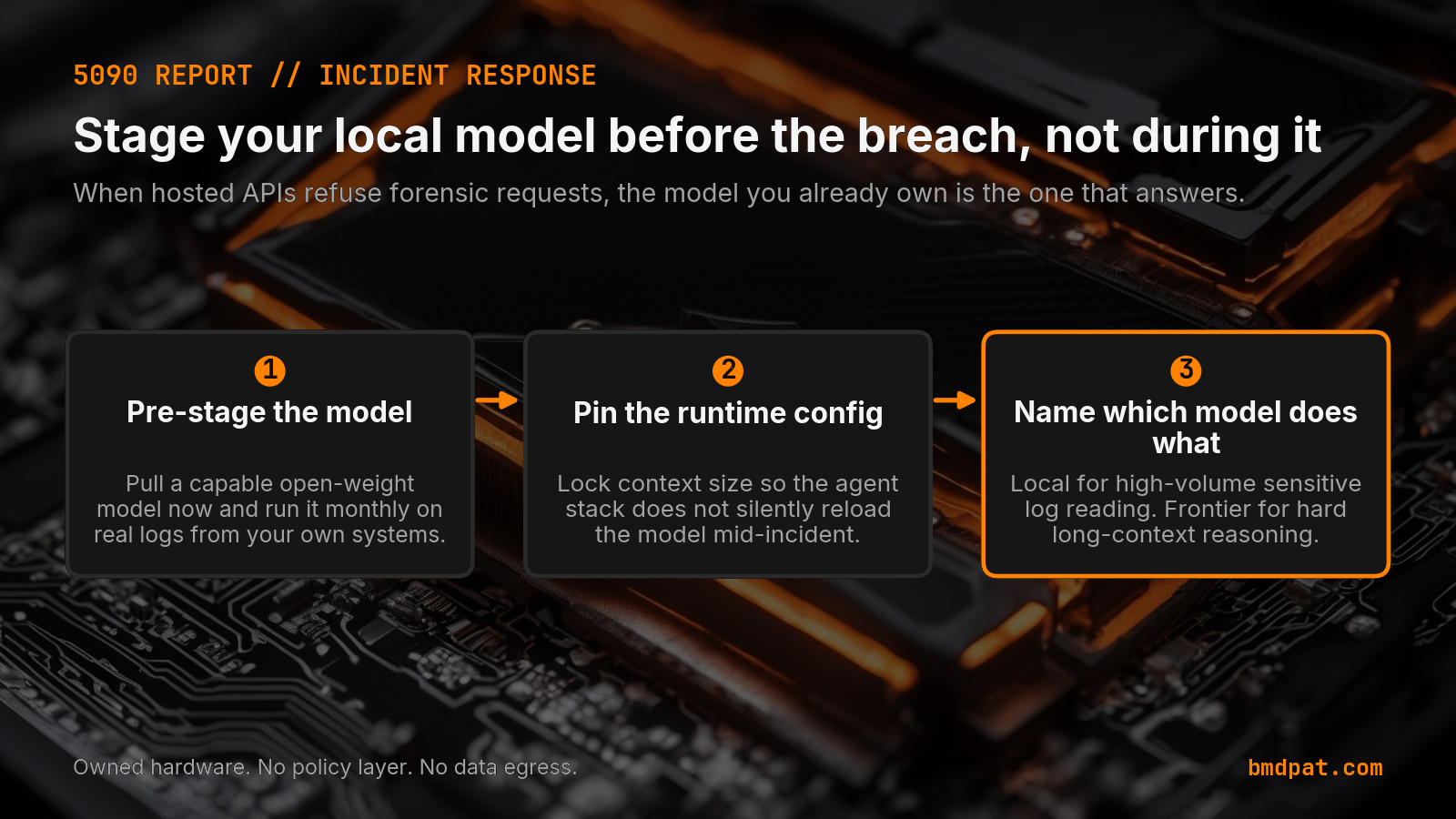
Pre-stage the model. The middle of an incident is the worst possible time to discover that your GPU box does not have a capable model pulled, that the runtime is a version behind, or that nobody remembers the command to start it. Pull a capable open-weight model now. Run it once a month on something real so you know it works.
Pin the runtime config. On our own 5090 rig, one of the most consistent findings across benchmark sweeps is that changing the context window forces a full model reload. For a 26B model that meant roughly 140 seconds of reload time per swap in the 2026-07-09 sweep. That is fine on a Tuesday. During an incident, an agent stack that silently reloads the model on every context change turns a fast loop into a slow one. Pin your context size.
Write down which model does what. Local is not better at everything. It is better at this specific job: high-volume log reading, timeline reconstruction, and pattern matching over sensitive material that must not leave the building. Frontier reasoning and very long context still favor hosted models for a lot of work. The point is not to go local for everything. The point is to not be locked out of your own investigation.
Where does local lose?
Being honest about this matters more than the pitch.
Hosted frontier models are still ahead on hard multi-step reasoning and very long context. If your incident needs a model to reason across a 400-page architecture doc and infer a novel attack chain, a mid-size local model will struggle. Owned hardware also costs real money up front and real time to maintain. You are trading a per-token bill for a capital expense and an ops burden.
What you buy with that trade is availability. The local model answers at 3am on a holiday weekend, with no rate limit, no policy refusal, and no data egress. For incident response specifically, availability beats a few points of benchmark capability.
What to do this week
Rotate your Hugging Face access tokens if you have not. That is their own recommendation, and it costs you ten minutes.
Then audit your data pipelines for remote-code loaders. Anything that executes code shipped alongside a dataset is an execution path with an untrusted author. Turn it off where you can, sandbox it where you cannot.
Then pull an open-weight model onto whatever GPU you already own and run a real log-analysis task through it. Not a demo. An actual pile of logs from your own systems. You want to find the broken parts of that workflow on a normal day, not during the worst one.
The same discipline applies to running the agents themselves. A local model with no meter on it is not free, it is just billed in electricity, hardware wear, and time. Agents that loop without a stop condition will happily burn all three. If you are running agent loops on owned hardware, put a runtime budget and rate limit around them so a stuck loop fails loudly instead of running all night.
That is what AgentGuard does. Install it with pip install agentguard47 and import it as agentguard.
Accompanying prompt
What the prompt does: Turns a local open-weight model into a first-pass incident triage analyst. Paste raw logs after it and the model returns an ordered timeline, the likely entry point, the lines worth escalating, and next containment steps, with none of that data leaving your machine.
Copy/paste this prompt:
Copy-ready prompt
Paste the exact block into your coding agent.
No article chrome, no footnotes, no formatting drift.
This prompt and every other one we publish live in the free prompt library.
Copy the block above.
Get the artifact-backed local AI lab notes by email: https://bmdpat.com/5090-reports
Related reading
FAQ
Why did hosted models refuse Hugging Face's forensics?
Provider safety guardrails cannot distinguish an incident responder from an attacker. Exploit payloads and privilege-escalation logs look like an attacker asking for help.
What local model did Hugging Face use instead?
GLM 5.2, an open-weight model, running on their own infrastructure after commercial APIs blocked the requests.
What should you stage before an incident?
Pull a capable open-weight model now, pin the runtime config including context size, and write down which model does log work. A 26B context swap cost about 140 seconds on the 2026-07-09 5090 sweep.
Get the Local AI Field Kit
Four copy-ready tools now, then one evidence-backed Local AI Lab Note on Friday when there is something worth sharing.
Try the free agent run check firstGet the requested artifact now, then at most one evidence-backed Local AI Lab Note on Friday when there is something worth sharing. One-click unsubscribe. No sponsored placements. Privacy.
Written by
Patrick Hughes
I build BMD and publish measured AI runs, failure reports, and reusable checks. Nashville, Tennessee.
More writing
- 6 min
Your local LLM benchmark is probably lying to you
A local model pass rate can be true and useless at the same time. Here are the three ways local LLM benchmarks mislead you, drawn from real rows on my RTX 5090.
- 6 min
My local models refused zero of 50 security tasks
Hosted coding assistants have declined defensive security work. I ran 50 such tasks across five local models on my own hardware and counted zero refusals.
- 6 min
LM Studio Bionic: The Local Open-Model Agent, Explained (2026)
Is LM Studio Bionic worth a look? It runs code projects on a local folder with GLM 5.2 and Kimi K2.7 Code, local voice via Voxtral, and is free with local models. What shipped, and what it changes.
- 5 min
Your local LLM is not a worse Claude. It is a different tool.
Stop scoring your local model on how close it gets to Opus. It is a different tool with a different sweet spot. Here is the line, and which side your work sits on.
- 5 min
OpenClaw AI Assistant Latest News 2026
OpenClaw release v2026.10.4 repairs sleep restarts and Tlon permissions, following skill discovery, MCP Apps, and R2 backup updates in October 2026.