How to Run Local LLM Verifier Loops on Owned Hardware
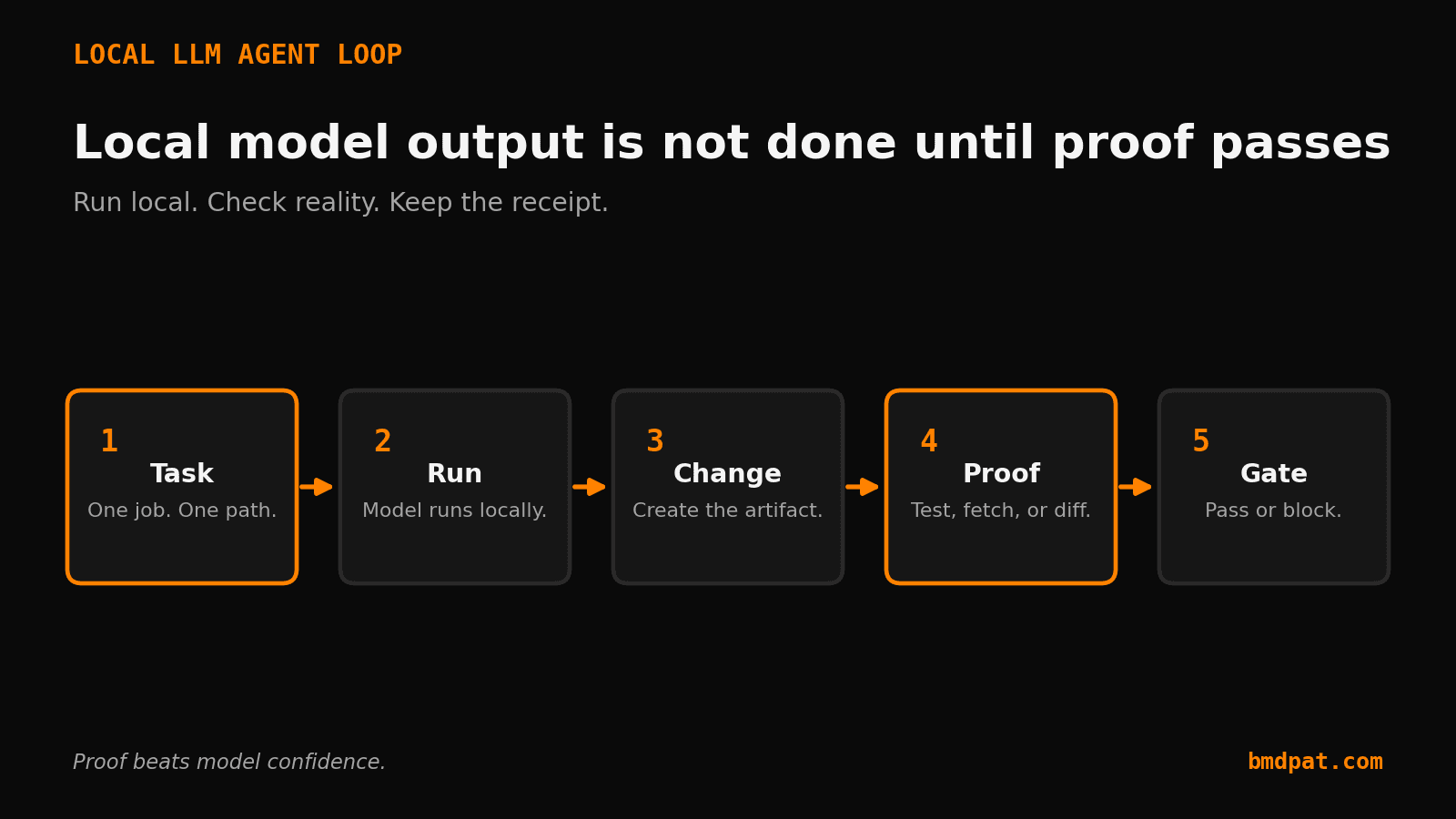
A local LLM workflow needs more than a model prompt. It needs a verifier loop that proves the file, command, URL, or report changed before the agent claims done.
TL;DR
- A local LLM verifier loop runs the model on private hardware, then runs a separate proof step before accepting the result. The proof can be a test, a file check, a browser readback, or a report diff.
- Give the model one task with the smallest useful scope. Let it edit or produce the artifact. Then run a proof step that does not depend on model confidence. If the proof fails, feed the exact failure back into one retry.
- If the task is publish a post, the proof is a live 200 on the public post URL. If the task is fix the scheduler, the proof is a task run result or a ledger row.
- One model run gets one job, one target path, and one proof command. The run also needs budget, token, and retry ceilings. The verifier asks whether the work passed. AgentGuard asks how much the agent can spend trying.
I do not trust a local coding agent because it sounds confident. I trust it when it leaves proof.
That is the difference between a local LLM demo and a local LLM workflow. The demo ends when the model prints a plausible answer. The workflow ends when a verifier checks the changed file, command, URL, report, or ledger row.
Summary: A local LLM verifier loop runs the model on private hardware, then runs a separate proof step before accepting the result. The proof can be a test, a file check, a browser readback, or a report diff. This is the part that turns owned hardware from a toy into a useful agent machine.
Why does local inference need a verifier loop?
Local inference gives me control. The model, prompts, logs, and files can stay on my hardware. That matters when I am testing agents against private notes and source trees.
Control is not the same as correctness.
A local model can still miss an import, skip a file, misunderstand a command, or claim a task is complete before the changed path is real. Smaller models make that failure more visible, so I give them tighter task framing and a harder proof gate.
The model proposes the work. The verifier decides whether reality changed.
What does the loop look like?
My default loop is boring on purpose.
First, give the model one task with the smallest useful scope. Let it edit or produce the artifact. Then run a proof step that does not depend on model confidence. If the proof fails, feed the exact failure back into one retry. If it fails again, write the block down.
For code, the proof is often a test command or typecheck. For content, it is a style scan, a rendered image check, and a live URL fetch. For an agent queue, it is a moved file plus frontmatter readback.
What should the verifier check?
Check the thing the user actually needs.
If the task is "publish a post," the proof is not "API call returned." The proof is a live 200 on the public post URL. If the task is "fix the scheduler," the proof is not "script edited." The proof is a task run result or a ledger row.
This keeps the local model honest without asking it to be perfect.
How do I choose the local model?
I start with the smallest model that can complete the narrow task with a verifier behind it.
That is a different question from "what model is smartest?" For local agent work, VRAM fit, context length, latency, and failure recovery matter. A smaller GGUF through llama.cpp can be fine for structured edits or report drafts.
If a model passes the proof often enough for the task, it earns more work. If it keeps failing the same proof, I change the prompt, the model, or the scope.
Where does owned hardware help?
I can run private vault tasks, repo scans, and draft repair loops without sending the whole working set to a hosted model. I can also rerun a verifier loop while I tune the prompt or model fit.
The catch is that local hardware makes every resource limit visible. VRAM decides what fits. Disk decides what can be cached. Power and heat decide how long a loop can run unattended.
How do I stop a local agent from running forever?
I put two boxes around it.
The first box is task scope. One model run gets one job, one target path, and one proof command. The second box is runtime policy. The run needs budget, token, and retry ceilings.
This is where AgentGuard fits my local setup. It is not the verifier. It is the guard rail around the run. The verifier asks, "did the work pass?" AgentGuard asks, "how much can this agent spend trying?"
What is the smallest useful version?
Start with a three-file setup.
Use one prompt file for the task. Use one script for the proof check. Use one report or ledger file for the result. Do not add a dashboard first. Make one loop that can fail loudly and leave a receipt.
A good first loop is a local draft repair agent. Give it one markdown file, one style checklist, and one scan. The output is either an approved draft with proof or a blocked note with the exact failure.
That pattern transfers to code, reports, and scheduler health.
Accompanying prompt
What the prompt does: It turns a local LLM task into a verifier loop with proof, retry limits, and AgentGuard runtime rails.
Copy/paste this prompt:
Copy-ready prompt
Paste the exact block into your coding agent.
No article chrome, no footnotes, no formatting drift.
This prompt and every other one we publish live in the free prompt library.
Copy the block above.
If you are building local agents that can spend tokens while you are away, do not rely on the prompt alone. AgentGuard puts hard budget, token, and rate limits around agent runs. Install it with pip install agentguard47, or read the docs at https://bmdpat.com/tools/agentguard
FAQ
Why does local inference need a verifier loop?
Control is not the same as correctness. A local model can miss an import, skip a file, or claim complete before the changed path is real. The model proposes. The verifier decides whether reality changed.
What should the verifier check?
The thing the user actually needs. Publish a post means a live 200. Fix the scheduler means a task run result or a ledger row. Not an API call returned or a script edited.
How do you stop a local agent from running forever?
Two boxes. Task scope: one job, one path, one proof command. Runtime policy: budget, token, and retry ceilings around the run.
Get the Local AI Field Kit
Four copy-ready tools now, then one evidence-backed Local AI Lab Note on Friday when there is something worth sharing.
Try the free agent run check firstGet the requested artifact now, then at most one evidence-backed Local AI Lab Note on Friday when there is something worth sharing. One-click unsubscribe. No sponsored placements. Privacy.
Patrick Hughes
I build BMD and publish measured AI runs, failure reports, and reusable checks. Nashville, Tennessee.
More writing
- 5 min
Use Owner Gates and AgentGuard to Keep AI Agents Moving
AI agents need two rails before they can run unattended: owner gates for judgment and AgentGuard for spend. Without both, the operator becomes the fallback.
- 5 min
3 Tests Before a GGUF Quant Runs Your Coding Agent
A GGUF file fitting in VRAM does not prove it can run your coding agent. Use this local acceptance test for tools, patches, and repeat runs.
- 6 min
My Agents Have to Prove What They Did
I extracted the claims ledger that runs my agent operation into showwork. Falsifiable claims, deterministic checks, and an exit gate that refuses a false done.
- 5 min
Q4_K_M vs Q5_K_M (q4km vs q5km): Which to Download? (2026)
Stuck between q4km and q5km? Verdict: start with Q4_K_M on 8–24GB cards; move to Q5_K_M only if it still fits with KV-cache headroom. The 5-minute VRAM check inside.
- 5 min
Local LLMs Need a Timeout Before They Need a Bigger Model
A bigger local model will not fix a stuck runtime. Add a bounded inference doctor first, then trust the benchmark.