How I Gate a Local Coding Model Before I Trust It
A local model is not ready because it runs fast. It is ready when one verifier loop can prove the output before an agent writes files.
TL;DR
- A local coding model should be promoted like a build step, not like a chat app. Pick one job, run it through the same prompt, verify the output with a deterministic command, and cap the runtime before the agent gets write access.
- On the July 2 5090 lab note, one Llama 3.1 8B Q4_K_M Ollama run reported 216.89 tokens/sec on a small local-agent-instrumentation task. That does not prove the model should edit real code.
- Start with one command that can say pass or fail without taste. The first gate should be deterministic. Do not ask another model whether the first model did a good job.
- Start with a cap that feels almost too small. One prompt. One task. One retry. One verifier command. If that fails, change the prompt, model, quant, or task size.
A local model does not earn trust because it answers once. It earns trust when the same prompt, same settings, and same verifier keep producing usable output under a cap.
Summary: A local coding model should be promoted like a build step, not like a chat app. Pick one job, run it through the same prompt, verify the output with a deterministic command, and cap the runtime before the agent gets write access. This is the path I use for owned hardware because fast wrong output still burns time.
Canonical URL: https://bmdpat.com/blog/local-model-verifier-loop-owned-gpu-2026
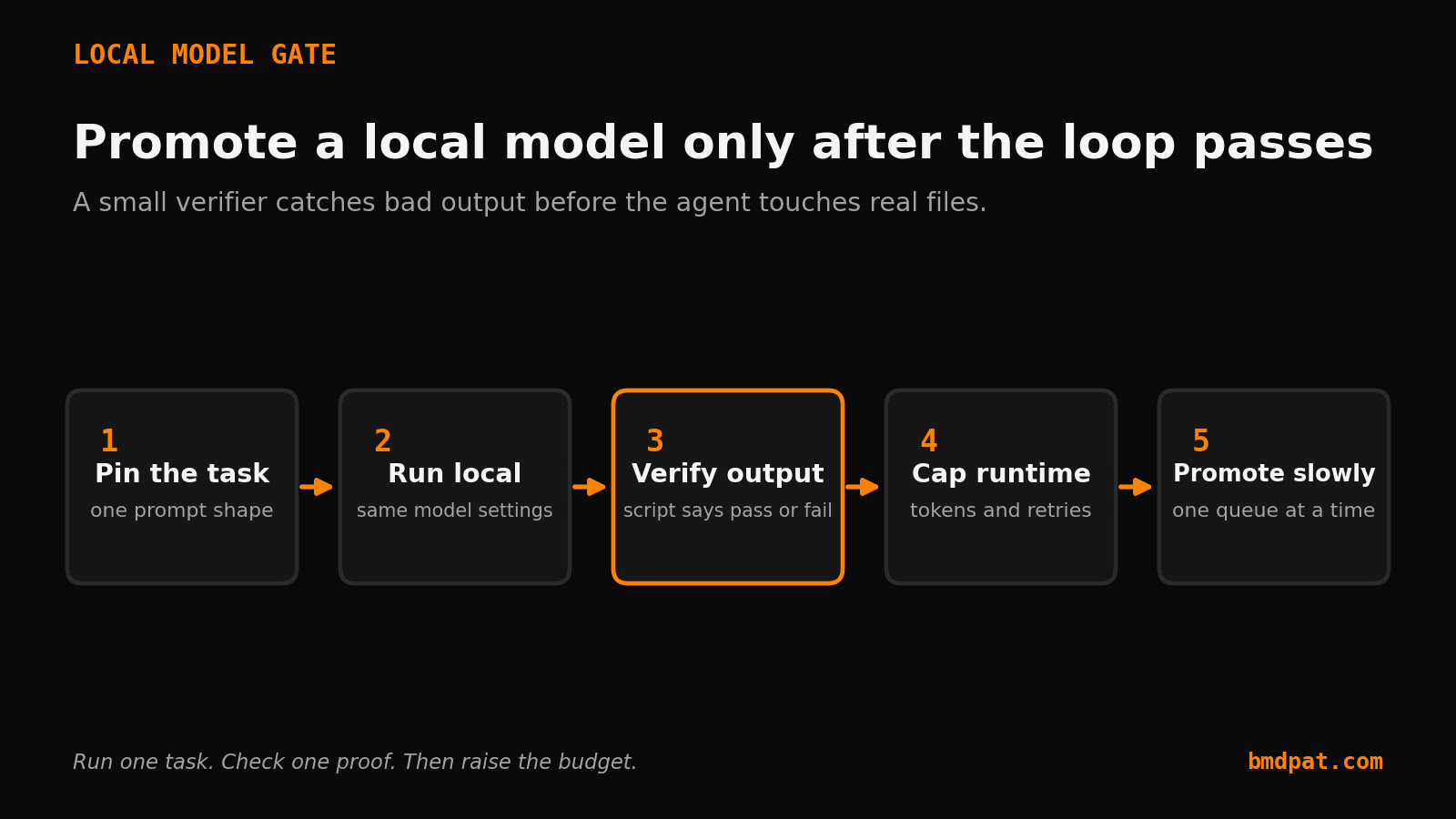
What makes a local model safe enough for coding agents?
A safe local model is not the biggest model that fits in VRAM. It is the smallest model that passes the job you need today.
For a coding agent, that job should be narrow. Summarize a run log. Rewrite one test. Classify a queue item. Draft a patch plan from a failing check. If the model cannot pass that small job with a verifier watching it, I do not let it touch larger work.
That rule matters more on owned hardware. A local GPU hides some cost pain because there is no API bill per token. The cost still exists. It shows up as time, heat, retries, and broken files.
Why does speed alone mislead local model work?
On my July 2 5090 lab note, one Llama 3.1 8B Q4_K_M Ollama run reported 216.89 tokens/sec on a small local-agent-instrumentation task. That is useful, but it is only a dated measurement on my machine. It does not prove the model should edit real code.
A fast model can still make a confident bad change. It can miss a file boundary. It can answer with a patch that looks right but fails the project test. It can spend ten retries circling the same broken idea.
So I treat speed as a capacity signal. I treat verifier pass rate as the trust signal.
What should the verifier check first?
Start with one command that can say pass or fail without taste.
For a coding task, that might be a unit test, a type check, a lint rule, or a small script that checks the exact output shape. For a report task, it might be a file-exists check plus a regex for required fields. For a queue task, it might be frontmatter status, completion date, and a live URL.
The verifier should be boring. It should not ask another model whether the first model did a good job. That can come later as review, but the first gate should be deterministic.
How do I set the first budget cap?
I start with a cap that feels almost too small.
One prompt. One task. One retry. One verifier command. If that fails, the model does not get more freedom. I change the prompt, model, quant, or task size.
The cap is not there because I hate exploration. It is there because local agents can create local mess fast. A budget turns failure into a small signal instead of a long cleanup job.
That is also where AgentGuard fits. The tool is not magic. It is a runtime guard for budgets, tokens, and rates around an agent loop. Local inference still needs that guard because local does not mean free.
What does promotion look like on owned hardware?
Promotion should be gradual.
First, the model runs against saved examples. Then it runs against a real queue item in dry-run mode. Then it writes to a scratch path. Then it can touch a low-risk queue with a verifier and a diff review. Only after that should it reach production files.
This is slower than saying the model is ready after one good chat. It is faster than cleaning up twenty bad edits after the model gets broad write access.
Owned hardware changes the economics. It does not change the engineering bar.
What should I measure before changing models?
Keep the first scoreboard plain.
Track the model name, quant, engine, task, input size, output size, tokens per second, verifier result, retry count, and wall time. Add GPU power if you already capture it. Skip anything you cannot collect without slowing the loop.
The point is not a public benchmark contest. The point is knowing whether a model change helped your actual agent job.
If a bigger model is slower but passes the verifier every time, it may win. If a smaller model passes the same gate faster, it may win. If neither passes, the task is too loose or the verifier is wrong.
How do I keep this from becoming process drag?
Use the verifier loop as a release gate, not a meeting.
Every model change should answer one question: did the local agent do the job under the cap? If yes, promote one step. If no, tighten the task or roll back.
This keeps local model work practical. You are not trying to prove the model is generally smart. You are proving it can do one job in your machine room today.
Accompanying prompt
What the prompt does: Builds a small pass/fail gate for one local model task before you let it touch real files.
Copy/paste this prompt:
Copy-ready prompt
Paste the exact block into your coding agent.
No article chrome, no footnotes, no formatting drift.
This prompt and every other one we publish live in the free prompt library.
Copy the block above.
If you are putting local models inside agents, put a budget and rate limit around the loop before it writes files. Try AgentGuard: https://bmdpat.com/tools/agentguard
FAQ
What makes a local model safe enough for coding agents?
Not the biggest model that fits in VRAM. The smallest model that passes the job you need today: summarize a run log, rewrite one test, classify a queue item, or draft a patch plan from a failing check.
Why does speed alone mislead local model work?
A fast model can still make a confident bad change. Treat speed as a capacity signal. Treat verifier pass rate as the trust signal.
How do you set the first budget cap?
One prompt, one task, one retry, one verifier command. If that fails, the model does not get more freedom. Change the prompt, model, quant, or task size instead.
Get the Local AI Field Kit
Four copy-ready tools now, then one evidence-backed Local AI Lab Note on Friday when there is something worth sharing.
Try the free agent run check firstGet the requested artifact now, then at most one evidence-backed Local AI Lab Note on Friday when there is something worth sharing. One-click unsubscribe. No sponsored placements. Privacy.
Patrick Hughes
I build BMD and publish measured AI runs, failure reports, and reusable checks. Nashville, Tennessee.
More writing
- 5 min
How I Make Local Model Runs Fail Safely On A 5090
A local model run should prove its safety path before it proves a score. Here is the small guardrail loop I use on my RTX 5090 for QLoRA starter work.
- 5 min
Local LLMs Need a Timeout Before They Need a Bigger Model
A bigger local model will not fix a stuck runtime. Add a bounded inference doctor first, then trust the benchmark.
- 5 min
My Local Blog Writer Drops Private Lines First
My local blog writer reads a daily log. I remove private lines before drafting, then check the output again. Here is what those checks can miss.
- 5 min
Ollama JSON: Empty Results Are Not Failed Requests
An empty Ollama result can mean no matches or a broken request. I test the response parser so local extraction failures cannot pass as clean results.
- 5 min
Log Local LLM Fallbacks Before You Score the Output
My local writer hit a host RAM guard, then Sonnet produced a draft that failed QA. Here is how I separate availability, model identity, and useful output.