Local LLMs Need a Timeout Before They Need a Bigger Model
A bigger local model will not fix a stuck runtime. Add a bounded inference doctor first, then trust the benchmark.
TL;DR
- Local LLM work needs a bounded inference doctor before model selection matters. On July 6 the 5090 Vault Model Lab added a hard wall-clock guard around an Ollama generation probe and verified llama3.1:8b.
- A health generation check timed out during launcher startup. A direct bounded llama3.1:8b request came back with OK. in 2.5 seconds, and the final health write returned status=ok.
- The live verification command was scripts\inference-doctor.ps1 -RestartOllama -Timeout 5 -GenerateWallTimeout 8 -Json. It returned status=ok, restart_attempted=false, and generation latency of 0.128s.
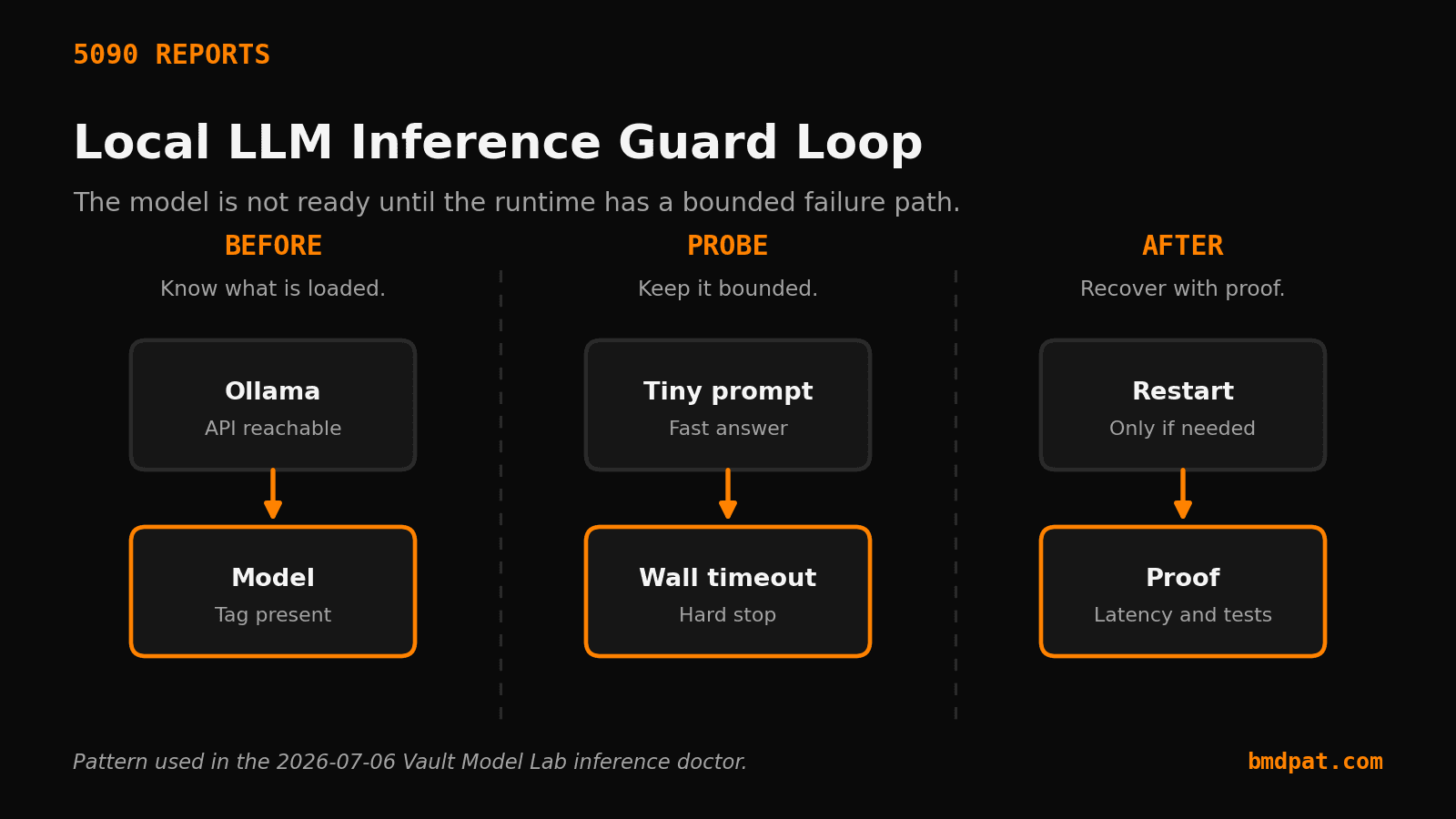
- Restart only after the bounded checks prove the service needs it. Probe first. Bound the probe. Restart only on evidence. Log the outcome.
The easiest way to waste a 5090 is to benchmark the model before the runtime can fail cleanly.
Short answer: Local LLM work needs a bounded inference doctor before model selection matters. On July 6, my 5090 Vault Model Lab added a hard wall-clock guard around an Ollama generation probe, verified llama3.1:8b, and proved the stack could recover without blindly restarting the service. Canonical URL: https://bmdpat.com/blog/local-llm-timeout-guard-ollama-5090-2026
What failed in the local runtime?
The local stack was not broken in a dramatic way. That is the point.
Ollama was reachable. The model tag existed. The RTX 5090 was visible. But a health generation check timed out during launcher startup. A direct bounded llama3.1:8b request came back with OK. in 2.5 seconds, and the final health write returned status=ok with model generation healthy.
That is the annoying failure shape for local AI. The machine is alive, but one probe can hang long enough to confuse the rest of the system. If the launcher treats every slow probe as a dead service, it will restart good infrastructure and hide the real timing bug.
Why is a wall timeout different from a normal timeout?
A request timeout is not enough when the model call itself can block the control loop.
The July 6 fix wrapped the Ollama generation probe in a wall-clock guard. The wrapper exposes -GenerateWallTimeout, so the operator can say, in plain terms, how long the health check is allowed to hold the process.
That matters because local inference has more moving parts than an API call. There is the model server, GPU memory, driver state, disk-backed model files, WSL visibility, and the calling script. If the guard only watches one layer, the whole launcher can still wait forever.
What should a local inference doctor check?
Mine now checks the things that decide whether a local agent can actually run.
It checks that the local API is reachable. It checks that the baseline model is present. It checks that the GPU is visible from Windows and WSL. It checks a tiny generation path with a hard wall timeout. It records whether a restart was attempted, what passed before generation, and how long generation took.
The live verification command was concrete: scripts\inference-doctor.ps1 -RestartOllama -Timeout 5 -GenerateWallTimeout 8 -Json. It returned status=ok, restart_attempted=false, before_generate.ok=true, and generation latency of 0.128s.
That is a useful result because nothing heroic happened. The doctor proved the service was healthy and avoided an unnecessary restart.
When should the runtime restart Ollama?
Restart only after the bounded checks prove the service needs it.
A restart is a blunt tool. It can clear a stuck model process, but it also destroys context for diagnosis. If every slow probe causes a restart, you do not know whether the model was dead, the caller blocked, the GPU was warming up, or the timeout was too tight.
The better rule is simple. Probe first. Bound the probe. Restart only on evidence. Log the outcome.
That rule turns a local model from a toy shell command into something an agent can depend on while you are away from the keyboard.
What did the 5090 lab prove today?
The July 6 5090 Vault Model Lab report showed the stack getting more boring, which is good.
The health path saw llama3.1:8b, an RTX 5090, WSL CUDA visibility, Python 3.10.12 in WSL, and more than 737 GB free on the E drive. The training preflight also failed the right way. It returned blocked_missing_training_deps, showed SFT progress at 29/500, found a gap of 471, and reported 0 schema errors.
That is the bar I want for owned hardware AI. Not magic. Not vibes. A machine that says what is ready, what is blocked, and which proof file backs the claim.
How do I apply this to my own local model loop?
Start with a small doctor script before you chase a bigger model.
Use one tiny deterministic prompt. Set a normal request timeout and a separate wall timeout. Check the model tag before generation. Check GPU visibility before generation. Write the JSON result every time. Keep the restart path explicit, and make it report whether it actually fired.
Then add tests around the failure modes. In my case, the focused inference doctor tests passed, then the full lab suite passed. That gave me enough confidence to wire the guard into the daily launcher path.
What is the takeaway?
A bigger model can make a good local stack more useful. It cannot make an unreliable runtime safe.
The order matters. First prove the boring path. Then prove the timeout path. Then prove the restart path. Only after that should tokens per second, quant choice, and model size get your attention.
Accompanying prompt
What the prompt does: It turns a local model launcher into a bounded inference doctor checklist.
Copy/paste this prompt:
Copy-ready prompt
Paste the exact block into your coding agent.
No article chrome, no footnotes, no formatting drift.
This prompt and every other one we publish live in the free prompt library.
Copy the block above.
If you are running agents on local or API models, put a hard budget and rate limit around them. Start with AgentGuard.
FAQ
What failed in the local runtime?
Ollama was reachable, the model tag existed, and the RTX 5090 was visible. A health generation check timed out during launcher startup. A bounded llama3.1:8b request returned OK. in 2.5 seconds.
Why is a wall timeout different from a normal timeout?
A request timeout is not enough when the model call itself can block the control loop. The wrapper exposes -GenerateWallTimeout so the health check has a hard wall-clock limit.
When should the runtime restart Ollama?
Restart only after bounded checks prove the service needs it. If every slow probe causes a restart, you cannot tell whether the model was dead, the caller blocked, the GPU was warming up, or the timeout was too tight.
Get the Local AI Field Kit
Four copy-ready tools now, then one evidence-backed Local AI Lab Note on Friday when there is something worth sharing.
Try the free agent run check firstGet the requested artifact now, then at most one evidence-backed Local AI Lab Note on Friday when there is something worth sharing. One-click unsubscribe. No sponsored placements. Privacy.
Patrick Hughes
I build BMD and publish measured AI runs, failure reports, and reusable checks. Nashville, Tennessee.
More writing
- 5 min
Your local LLM is not a worse Claude. It is a different tool.
Stop scoring your local model on how close it gets to Opus. It is a different tool with a different sweet spot. Here is the line, and which side your work sits on.
- 4 min
How I Gate a Local Coding Model Before I Trust It
A local model is not ready because it runs fast. It is ready when one verifier loop can prove the output before an agent writes files.
- 5 min
My Local Blog Writer Drops Private Lines First
My local blog writer reads a daily log. I remove private lines before drafting, then check the output again. Here is what those checks can miss.
- 5 min
Ollama JSON: Empty Results Are Not Failed Requests
An empty Ollama result can mean no matches or a broken request. I test the response parser so local extraction failures cannot pass as clean results.
- 5 min
Log Local LLM Fallbacks Before You Score the Output
My local writer hit a host RAM guard, then Sonnet produced a draft that failed QA. Here is how I separate availability, model identity, and useful output.