My Agents Have to Prove What They Did
I extracted the claims ledger that runs my agent operation into showwork. Falsifiable claims, deterministic checks, and an exit gate that refuses a false done.
TL;DR
- One agent reported three completed actions. Two were false. The model produced a convincing final answer. The repository did not match it. Every material completion now needs a check that can fail.
- showwork is open source on GitHub and PyPI. It verifies explicit file and command checks. A passing check proves only what it tests; coverage of the user's request still needs review.
- If a claim is RED, the clean close is refused. Exit code 2. Fix reality, retract the claim, or finish as blocked. The command checker has no shell. It only permits a Python script under the project root.
I stopped trusting "done."
One of my agents reported three completed actions. Two were false. The model produced a convincing final answer. The repository did not match it.
The tool trace looked busy. The summary sounded sure. Nothing in that chat proved the side effects landed.
So I made a rule for the operation: every material completion needs a check that can fail.
That layer is now open source as showwork. It is on PyPI.
pip install showwork
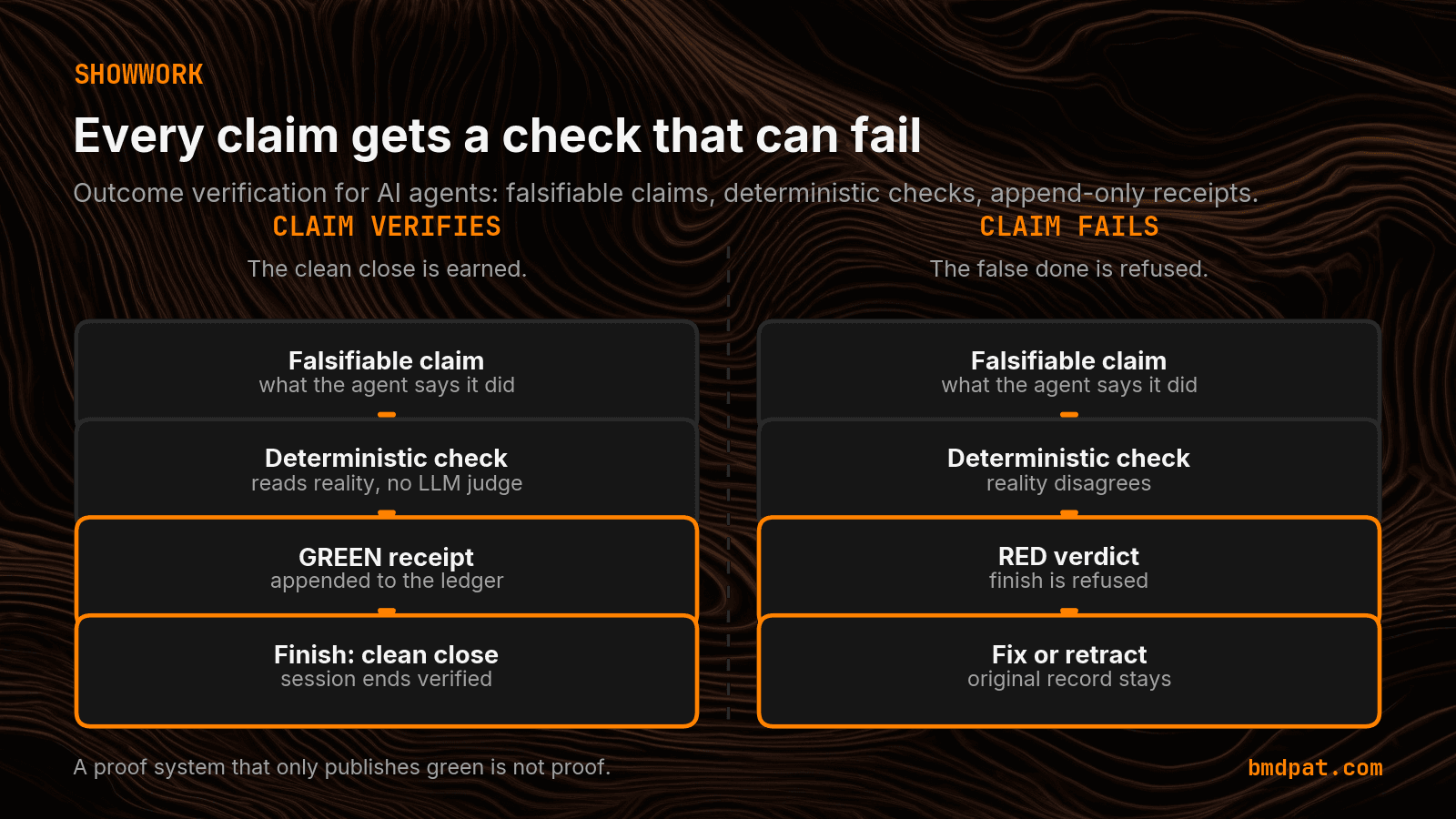
What does showwork verify?
Observability answers, "What did the agent do?"
showwork answers, "Is the outcome it claimed actually true?"
The first question needs traces. The second needs a falsifiable assertion and a deterministic checker. No LLM judging an LLM.
showwork start --session fix-timeout --agent claude-code

showwork claim --session fix-timeout \
 --claim "bumped billing-sync API timeout to 30s" \
 --type file_contains --path config/api.yaml --pattern "timeout: 30"

showwork finish --session fix-timeout --status ok
If a claim is RED, the clean close is refused. Exit code 2. Fix reality, retract the claim, or finish as blocked.
The command checker has no shell. It only permits a Python script under the project root. It rejects shell metacharacters, path escape, and recursive verification. Other checks cover files, content, path moves, frontmatter, and file counts. Vacuous patterns (regex that match empty strings, always-true counts) are rejected, not blessed.
Why is the ledger append-only?
Agents will be wrong. Operators will also be wrong. Deleting a bad assertion makes the record look cleaner while destroying the most useful evidence.
showwork appends a retraction that names the earlier claim and explains the correction. The original record stays. Failures become training material for the operation.
Does it gate the session?
Yes, through the explicit finish command. Observation and gating stay separate.
showwork finish --session fix-timeout --status ok
The Claude Code Stop-hook adapter records a verdict when a session stops, but always exits 0. It observes. It does not block. The gate is the finish call your prompt contract requires.
What proof came before the package?
I derived a sanitized snapshot from the private ledger that runs the operation:
- 2,158 claims recorded
- 2,152 backed by deterministic checks
- 842 sessions represented
- 152 append-only retractions
- One malformed ledger line surfaced
- Captured verdict: RED, 54 of 60 verified
I kept the RED result. A proof system that only publishes green is not proof.
The derivation publishes aggregates plus a source fingerprint. It does not copy private claim text, paths, strategy, or financial values.
Why publish a specification?
The package can be copied. The record format can outlive it.
spec-v0.1 defines the JSONL schema, checker semantics, anti-vacuous rules, retractions, verdict algebra, session events, and exit-gate contract. Every normative requirement names a behavioral test.
Another team can implement the same evidence format in Go or TypeScript. That is more useful than forcing every agent stack through one Python process.
What is the artifact?
- Installable CLI and Python API:
pip install showwork - Portable ledger specification
- Claude Code Stop-hook adapter
- Genesis receipt where the repository verified its own tests
- Sanitized case study and derivation script
- Marketing demo cut: agents say done, finish is REFUSED, then GREEN after reality matches
Code: github.com/bmdhodl/showwork PyPI: pypi.org/project/showwork
Where runtime limits fit
Verification is one half of trusting an unattended agent. The other half is bounding what the agent can do before it does it.
showwork proves what an agent did after the fact. It does not stop an agent from looping, over-calling a paid API, or draining a token budget on the way to a wrong answer. Those are runtime questions, and they need a runtime limit.
That is the job of AgentGuard: hard caps on tokens, cost, and call rate around an agent run, enforced while the agent is still running. AgentGuard bounds what an agent can spend. showwork proves what an agent actually produced. Run both and an unattended agent has a ceiling on the way in and a receipt on the way out.
Related reading
Accompanying prompt
What the prompt does: turns an agent's vague "done" report into falsifiable claims with deterministic checks you can run yourself.
Copy/paste this prompt:
Copy-ready prompt
Paste the exact block into your coding agent.
No article chrome, no footnotes, no formatting drift.
This prompt and every other one we publish live in the free prompt library.
Copy the block above.
Get the artifact-backed local AI lab notes by email: https://bmdpat.com/5090-reports
FAQ
What does showwork verify?
Explicit file and command checks. Version 0.6.0 requires declared acceptance checks for an outcome close. It cannot prove that a test covers the user's request or that omitted requirements were met.
What happens when a claim is RED?
finish --status ok is refused with exit code 2. Fix reality, retract the claim, or finish as blocked.
Why is the ledger append-only?
Deleting a bad assertion makes the record look cleaner and destroys the evidence. A retraction names the earlier claim and explains the correction. The original record stays.
Get the Local AI Field Kit
Four copy-ready tools now, then one evidence-backed Local AI Lab Note on Friday when there is something worth sharing.
Try the free agent run check firstGet the requested artifact now, then at most one evidence-backed Local AI Lab Note on Friday when there is something worth sharing. One-click unsubscribe. No sponsored placements. Privacy.
Patrick Hughes
I build BMD and publish measured AI runs, failure reports, and reusable checks. Nashville, Tennessee.
More writing
- 5 min
Ollama Raised $65M. What Builders Get
Ollama's $65M round and 8.9 million developers make local AI a funded product category. Here is what changes for builders on owned GPUs.
- 5 min
3 Tests Before a GGUF Quant Runs Your Coding Agent
A GGUF file fitting in VRAM does not prove it can run your coding agent. Use this local acceptance test for tools, patches, and repeat runs.
- 6 min
Your Agent's Audit Trail Cannot Be Retrofitted
Agent logs show activity. They do not prove the outcome an agent claimed. Here is the verification layer I added after an agent reported two false dones.
- 5 min
Local LLMs Need a Timeout Before They Need a Bigger Model
A bigger local model will not fix a stuck runtime. Add a bounded inference doctor first, then trust the benchmark.
- 4 min
How I Gate a Local Coding Model Before I Trust It
A local model is not ready because it runs fast. It is ready when one verifier loop can prove the output before an agent writes files.