Ollama Raised $65M. What Builders Get
Ollama's $65M round and 8.9 million developers make local AI a funded product category. Here is what changes for builders on owned GPUs.
TL;DR
- TechCrunch reported a $65 million Series B. Ollama says it has raised $88 million in total and serves 8.9 million developers.
- A local request does not create a provider token charge. Real costs are the GPU, electricity, model load time, cooling, maintenance, and operator time when the runtime fails. Owned compute is prepaid compute.
- Ollama says funding will support hybrid inference, faster access to new open models, and cloud access without giving up the local product. Builders still own timeouts, retry caps, tool logs, and a verifier before writes.
Ollama just turned local AI from a developer preference into a funded product category. The money matters less than what it will buy: better model access, more predictable runtimes, and a clearer path between a workstation and cloud capacity.
The short answer: TechCrunch reported a $65 million Series B, while Ollama says it has raised $88 million in total and serves 8.9 million developers. That does not prove every workload should move local. It does mean builders can expect the local model on-ramp to keep improving. Canonical URL: https://bmdpat.com/blog/ollama-raises-65m-what-it-means-for-local-ai-builders-2026
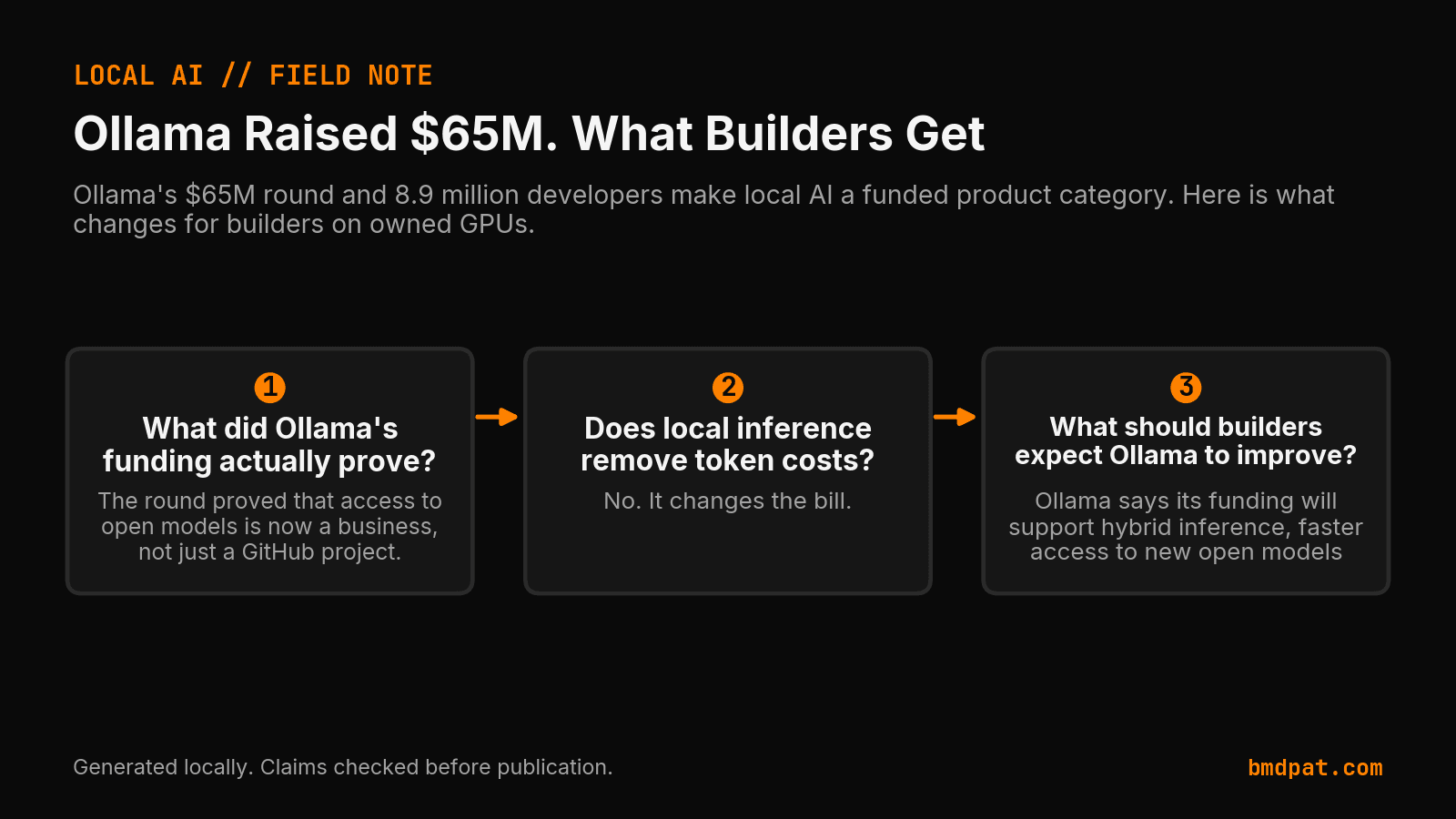
What did Ollama's funding actually prove?
The round proved that access to open models is now a business, not just a GitHub project. Ollama's official announcement centers on ownership, privacy, local execution, and an optional cloud path for models that do not fit on one machine. That is a practical product map.
I read the signal this way: local inference no longer has to win every benchmark. It only has to own a useful class of work. Drafting, extraction, classification, private retrieval, and repeatable agent steps are good candidates. Hard reasoning and occasional long-context work can still go to a frontier API.
That split is already how I use my RTX 5090. Ollama handles repeatable local work. A frontier model handles the final QA gate when the output will publish or change an important system. The local model buys capacity. The verifier buys trust.
Does local inference remove token costs?
No. It changes the bill.
A local request does not create a provider token charge. The real costs are the GPU, electricity, model load time, cooling, maintenance, and the attention needed when the runtime fails. If the hardware already exists and the workload runs often, the marginal request cost can be small. If the workload is rare or needs the best available reasoning, an API may still be cheaper.
This is why I avoid the phrase "free inference." Owned compute is prepaid compute. The useful comparison is workload by workload: requests per day, latency target, privacy boundary, model size, and how much operator time the local path consumes.
My consumer GPU production guide covers the operating side. The deciding question is not "local or cloud?" It is "which steps are stable enough to own?"
What should builders expect Ollama to improve?
Ollama says its funding will support hybrid inference, faster access to new open models, and cloud access without giving up the local product. Those are useful priorities because model serving has three separate problems.
First, the model must fit. Quantization, context size, and KV cache decide whether a run stays inside VRAM. Second, the runtime must stay loaded and answer consistently. Third, the surrounding agent must fail safely when the model stalls, repeats, or calls the wrong tool.
The funding can improve the first two. Builders still own the third.
For example, changing context size can force a full model reload. I documented that failure in my Ollama context reload field note. A friendlier runtime does not remove the need to pin settings, measure reloads, and keep a bounded fallback.
How should a local agent fail safely?
Treat the model server and the agent as separate systems. Ollama produces tokens. Your agent decides what those tokens are allowed to do.
I put timeouts around generation, cap retries, log tool calls, and require a verifier before writes. If a task needs filesystem or network access, the runtime also needs explicit limits. A loop that costs no provider tokens can still burn an afternoon, corrupt files, or hold a GPU indefinitely.
That is where AgentGuard's runtime limits fit. The point is not to make Ollama safe by association. The point is to bound the code around any model, local or hosted, before it receives tools.
The best local-first design is boring. Route repeatable work to the owned GPU. Measure it. Escalate the hard cases. Verify every consequential result.
What changes for builders now?
The local path has stronger financial backing and a large developer base. That should improve the on-ramp. It does not change the engineering decision.
Start with one bounded workload. Record model, quant, context, latency, failure mode, and verifier result. Compare that row with the same task on an API. Keep the route that wins on cost, privacy, availability, and operator time.
Ollama's round is useful because it gives that experiment a longer runway. Your own measurements still decide where local inference belongs.
Accompanying prompt
What the prompt does: It turns one workload into a measured local-versus-cloud routing decision with explicit pass and fail rules.
Copy/paste this prompt:
Copy-ready prompt
Paste the exact block into your coding agent.
No article chrome, no footnotes, no formatting drift.
This prompt and every other one we publish live in the free prompt library.
Copy the block above.
I publish measured local runs, failure notes, and routing decisions in The 5090 Reports. Join the email list to get the next field note.
FAQ
What did Ollama's funding prove?
Access to open models is now a business. The official announcement centers on ownership, privacy, local execution, and an optional cloud path for models that do not fit on one machine.
Does local inference remove token costs?
No. It changes the bill. There is no provider token charge. The GPU, electricity, load time, cooling, maintenance, and operator time still count.
What should a local agent still bound?
Timeouts around generation, retry caps, tool-call logs, a verifier before writes, and explicit filesystem or network limits. A loop with no provider token bill can still burn an afternoon.
Get the Local AI Field Kit
Four copy-ready tools now, then one evidence-backed Local AI Lab Note on Friday when there is something worth sharing.
Try the free agent run check firstGet the requested artifact now, then at most one evidence-backed Local AI Lab Note on Friday when there is something worth sharing. One-click unsubscribe. No sponsored placements. Privacy.
Patrick Hughes
I build BMD and publish measured AI runs, failure reports, and reusable checks. Nashville, Tennessee.
More writing
- 3 min
Devlog 2026-07-13: local drive git corruption stalls the q
The nightly queue sweep aborted for the fourth straight night. The root cause is a critical failure in the vault health check. I discovered a private path wo...
- 5 min
My Local Blog Writer Drops Private Lines First
My local blog writer reads a daily log. I remove private lines before drafting, then check the output again. Here is what those checks can miss.
- 5 min
Ollama JSON: Empty Results Are Not Failed Requests
An empty Ollama result can mean no matches or a broken request. I test the response parser so local extraction failures cannot pass as clean results.
- 5 min
Log Local LLM Fallbacks Before You Score the Output
My local writer hit a host RAM guard, then Sonnet produced a draft that failed QA. Here is how I separate availability, model identity, and useful output.
- 5 min
My local daily brief used 0 model calls
On September 4, 2026 my llama3.1:8b daily brief was ready with 0 model calls and 0 seconds. Preview-only file ranking is not a model run.