3 Tests Before a GGUF Quant Runs Your Coding Agent
A GGUF file fitting in VRAM does not prove it can run your coding agent. Use this local acceptance test for tools, patches, and repeat runs.
A model can fit in VRAM, answer one prompt, and still fail as a coding agent. I do not keep a quant because one chat reply looks good. I keep it after it completes the same small tool loop more than once.
Short answer: Test a local coding model on file reading, a bounded patch, and a real test command. Keep the prompt, tools, context, and pass rules fixed. Pick the smallest quant that passes every gate across repeated runs.
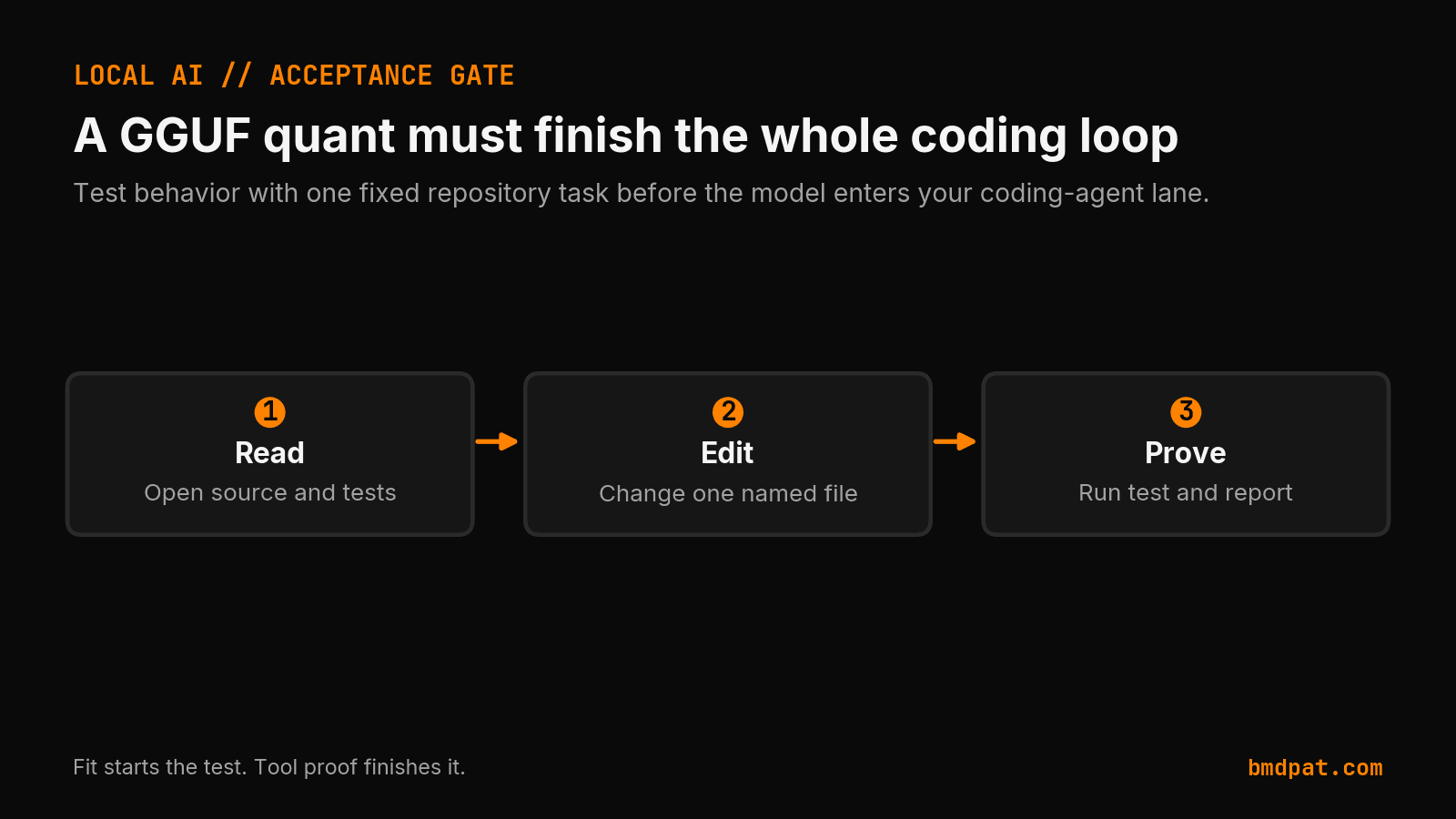
Why is VRAM fit only the first gate?
Fit tells me whether I can start the model. It does not tell me whether the model can follow a tool schema, respect a file boundary, or report a failed command.
I solve fit first. I check the file size, context target, and GPU offload plan. My GGUF quant guide covers that choice, and my --n-gpu-layers guide covers the offload check.
Then I stop changing runtime settings. A moving setup makes the result hard to compare.
This post decides one thing: which quant file I keep for a coding agent. My Q4_K_M vs Q5_K_M guide picks a quant on paper, before the download. This one picks the file by running it.
What three tests do I run?
I use one small repository fixture. It has a short source file, a focused test, and one rule that the model must preserve.
The first test is read. I ask the model to open the source and test files. It must state the rule before it proposes a change. This catches models that guess from filenames or from the task text.
The second test is edit. I ask for one bounded change in one named file. The model must not touch nearby code, add a package, or rewrite the test to make it pass.
The third test is proof. I ask the model to run the focused test and report the command, exit code, and result. A claim without command output does not pass.
How do I keep the comparison fair?
I keep the same model family, prompt, repository state, context limit, tool definitions, and backend version. I change only the quant under test.
I also reset the fixture before each run. Cached files and prior edits can hide a weak result. I use three runs per quant because one clean run can be luck. This is my acceptance rule, not a universal benchmark.
I set temperature to zero when the backend supports that setting. The output can still vary, so I score behavior instead of exact wording.
The stop reason is the part I can show from a measured run. On 2026-07-09 I ran llama3.1:8b and gemma4:26b, both Q4_K_M, on Ollama 0.31.1 with the agent-code-task-512 workload. Both used num_ctx=4096, num_predict=512, and temperature=0.
That pair shows why the proof gate matters. llama3.1:8b stopped on its own at 459 output tokens. gemma4:26b ran to 512 tokens and stopped because it hit the cap, not because it finished. A truncated patch can still read like a complete one, so I check the stop reason before I score the run.
What makes a quant fail?
I reject a run when the model invents file content, sends invalid tool input, edits outside the named file, changes a test without permission, or calls a failed test successful.
I also reject an incomplete run. A useful explanation does not replace the requested patch and command proof. The agent must finish the small loop.
One safety or boundary failure rejects that run. Style differences do not. I care about the action and its proof.
How do I choose between Q4_K_M and Q5_K_M?
I run the same acceptance set against both files. I do not assume the larger file wins. I keep the smaller quant if it passes all three cases in all three runs.
If Q4_K_M misses a tool call and Q5_K_M passes, I keep Q5_K_M when it still fits my target context. If both pass, I keep Q4_K_M and use the saved memory for context or another process.
If neither passes, I stop. More prompt text rarely repairs a model that cannot follow the basic loop. I test another model family or move that task to a stronger endpoint.
What should the test record contain?
I record the model name, quant, backend version, context limit, GPU layer setting, prompt, tool results, changed files, test command, and exit code. I keep failed rows.
The failed rows explain why a model did not enter the coding-agent lane. They also stop me from repeating the same download and setup work later.
This record turns model choice into a local decision. I can rerun it after a backend update, a new quant, or a tool-schema change. The gate stays the same even when the model changes.
Accompanying prompt
What the prompt does: It tests one GGUF quant against a fixed read, edit, and proof loop for a local coding agent.
Copy/paste this prompt:
Copy-ready prompt
Paste the exact block into your coding agent.
No article chrome, no footnotes, no formatting drift.
This prompt and every other one we publish live in the free prompt library.
Copy the block above.
Get the next measured local-AI field note by email: The 5090 Reports.
Get the Local AI Field Kit
Four copy-ready tools now, then one evidence-backed Local AI Lab Note on Friday when there is something worth sharing.
Try the free agent run check firstGet the requested artifact now, then at most one evidence-backed Local AI Lab Note on Friday when there is something worth sharing. One-click unsubscribe. No sponsored placements. Privacy.
Written by
Patrick Hughes
I build BMD and publish measured AI runs, failure reports, and reusable checks. Nashville, Tennessee.
More writing
- 5 min
One model logged 14.5 and 6,178 prompt tokens a second
gemma4:26b read 53 prompt tokens at 14.5 tok/s and 4,470 at 6,178.9 on the same RTX 5090 run set. Prompt speed is not one number.
- 5 min
49W Average Hid a 338W Burst on Gemma 26B
Gemma 4 26B Q4_K_M averaged 49 W on a long RTX 5090 run and peaked at 338 W. Keep both watt numbers before you compute energy per token.
- 5 min
My local LLM eval hid four token caps
My 5090-rig eval uses four output caps: 50, 180, 192, and 256 tokens. A score without the cap is not a model result. Record the cap on every row.
- 5 min
A 7 GB 27B Model Lost to My 17 GB Default
A 6.66 GiB ternary 27B model fit my RTX 5090, but it lost the default slot. File size is only the first local model-selection gate.
- 6 min
My Agents Have to Prove What They Did
I extracted the claims ledger that runs my agent operation into showwork. Falsifiable claims, deterministic checks, and an exit gate that refuses a false done.