How to Route Local LLM Workloads with Open Weights
Open weights match coding parity while cloud models lead on reasoning. Route your 5090 workloads using verified 2026 inference pricing and benchmark data.
You should route high-volume coding and deterministic generation tasks to local open weights on your 5090, while keeping complex reasoning and long-context retrieval on cloud endpoints.
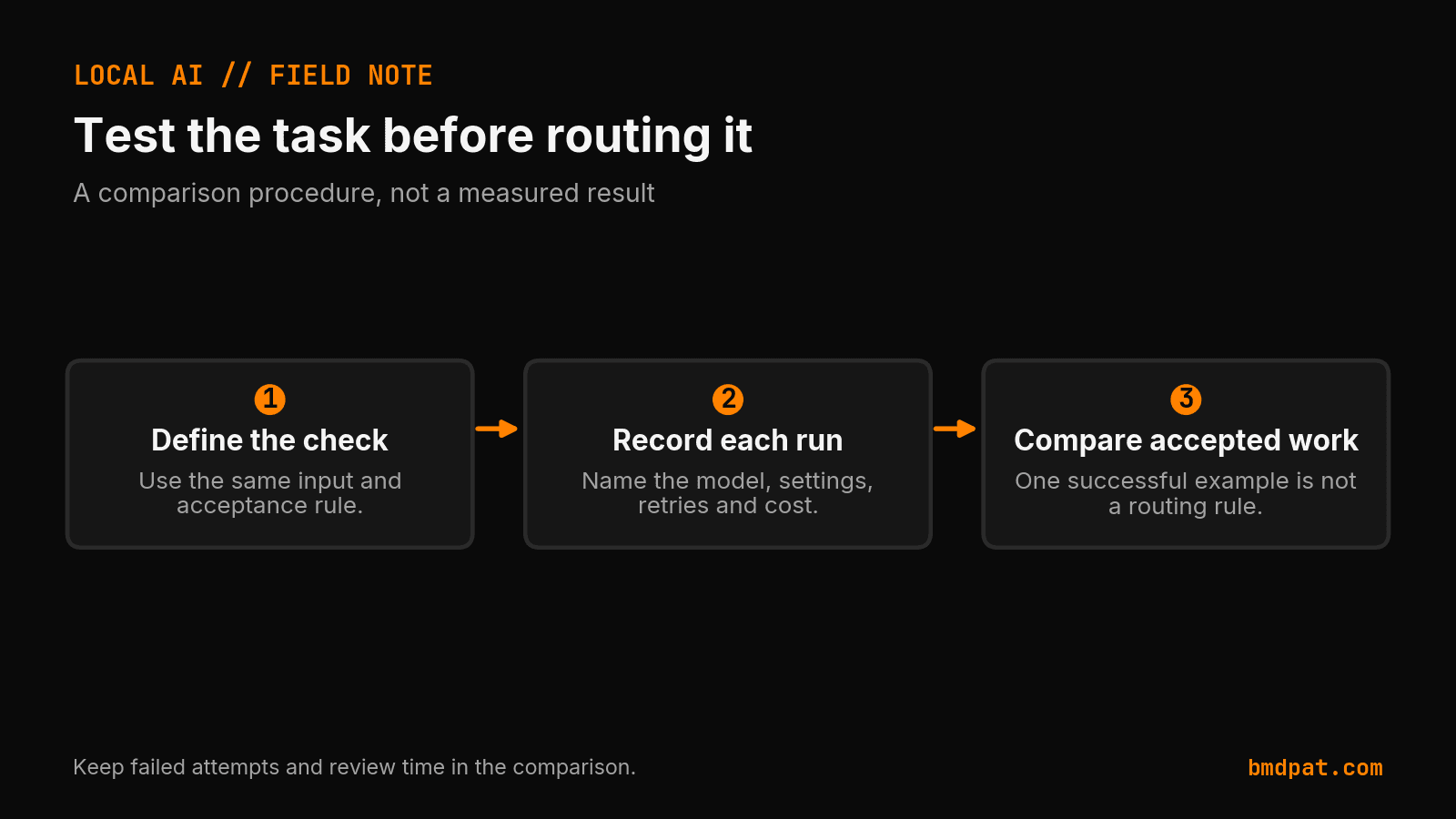
The card above is an older field note. It is a routing procedure, not a chart of the token share or the price drops below.
What do the 2026 open-weight reports show?
The July 16, 2026 research packet shows open-weight models reached coding parity with proprietary systems while lagging behind on reasoning, long-context retrieval, and agent tasks. It also highlights shifting production share on OpenRouter, driven by steep price drops across the industry.
The findings come from two separate publications. First, the primary report at stateofopensource.ai examines workload performance and token distribution. It found open-weight models match proprietary models on routine coding tasks. However, closed models maintain their lead when tasks demand multi-step reasoning, retrieval over long contexts, or tool use. The report also examines production volume: an OpenRouter 100T-token study found open weights account for roughly one-third (~33%) of production tokens, while August marked the first month an open model led the leaderboard on request counts.
The primary report also displays an internal contradiction on pricing history. A summary card on the page claims a -29x drop. Yet the detailed section of the report charts a 50x decline, showing GPT-4-class inference fell fifty-fold per 1M tokens over 36 months. The endpoint math matches 50x. The page presents both figures side by side without reconciling the discrepancy.
Independent research confirms rapid price drops. Analysis published by a16z reports roughly a 10x annual decline in equivalent-capability inference pricing, using historical MMLU evaluations. The authors note methodology limits, but the directional trend matches the primary report.
| Workload or Metric | Report Finding | Source Attribution |
|---|---|---|
| Coding tasks | At or near parity with closed models | stateofopensource.ai |
| Reasoning and agent tasks | Closed models maintain a clear lead | stateofopensource.ai |
| Long-context retrieval | Closed models lead | stateofopensource.ai |
| GPT-4-class inference pricing | Fell 50x per 1M tokens over 36 months | stateofopensource.ai |
| Production token volume | Open weights account for roughly one-third (~33%) of tokens; open model led request counts | stateofopensource.ai |
| Annual capability cost trend | Roughly 10x annual decline with methodology caveats | a16z |
Why does lower inference pricing alter local hardware planning?
Falling cloud token costs do not eliminate the value of local hardware, but they change how you justify it. When cloud prices drop fifty-fold per million tokens, owned GPUs make financial sense only for continuous, bounded token workloads rather than occasional general queries.
Local hardware requires capital expenditure, continuous electricity, cooling, and ongoing system administration. When API calls cost pennies, running an underutilized desktop GPU wastes money. You cannot justify hardware by running ten prompts a day. You justify hardware when you run steady batch jobs, private repository analysis, or continuous unit test generators.
Hardware constraints also dictate model selection. A single desktop card cannot host large frontier models without severe compromise. Memory capacity determines what you can run. Before downloading model weights, check our VRAM calculator to verify fit. You must quantize large weights to run them locally. Read our GGUF quantization explained guide to balance precision against memory footprints across Q4, Q5, and Q8 levels. When configuring production services on your machine, review our 5090 local inference guide for stable operational settings.
Which workloads belong on your 5090?
You should run repetitive coding transformations, formatting passes, and high-volume local tests on your 5090 where open weights match closed performance. Keep multi-step autonomous planning, deep reasoning chains, and large context retrieval on closed cloud endpoints where proprietary models still hold a documented technical lead.
The report evidence gives you a clear boundary. Open weights match proprietary models in coding. You can run automated refactoring, boilerplate creation, docstring generation, and local test synthesis on your own card. These tasks burn millions of tokens during active development. Running them locally eliminates per-call API charges, keeps your internal code private, and provides zero-latency loops.
Save cloud spend for tasks where open weights struggle. Complex planning workflows fail when models lack strong reasoning capabilities. When an autonomous workflow needs to synthesize multi-step plans or search large retrieval databases, send those calls to cloud endpoints. A mixed setup routes work where each model excels.
What should you do with this?
You should audit your weekly prompt volume, route coding workloads to your local GPU, and keep complex reasoning tasks on cloud APIs. This split gives you the cost benefits of owned hardware without degrading the quality of difficult tasks that open models cannot reliably solve.
- Audit your task log: Review your execution history. Group calls into code generation, simple formatting, complex reasoning, and long-context retrieval.
- Quantize and test your local model: Use GGUF quantization to fit a capable open coding model into your available GPU memory, verifying that layers fit without system RAM spillover.
- Establish a routing fallback: Direct high-frequency coding requests to your local 5090 instance, and configure your pipeline to escalate failed runs or reasoning-intensive steps to cloud endpoints.
Accompanying prompt
What the prompt does: Audits an engineering task log to route coding jobs to local weights and reasoning jobs to cloud endpoints.
Copy/paste this prompt:
Copy-ready prompt
Paste the exact block into your coding agent.
No article chrome, no footnotes, no formatting drift.
This prompt and every other one we publish live in the free prompt library.
Copy the block above.
Weekly measured local runs: https://bmdpat.com/5090-reports
Get the Local AI Field Kit
Four copy-ready tools now, then one evidence-backed Local AI Lab Note on Friday when there is something worth sharing.
Try the free agent run check firstGet the requested artifact now, then at most one evidence-backed Local AI Lab Note on Friday when there is something worth sharing. One-click unsubscribe. No sponsored placements. Privacy.
Patrick Hughes
I build BMD and publish measured AI runs, failure reports, and reusable checks. Nashville, Tennessee.
More writing
- 5 min
My agent leaked an authority key and aborted the sweep
On 2026-10-07, an agent leaked an authority credential at startup. The nightly sweep aborted, and containment comes before any new code.
- 5 min
Bonsai 27B vs Gemma 4 E4B: Which Should You Run?
Compare Ternary Bonsai 27B and Gemma 4 E4B for local AI. See VRAM footprints, multimodal support, benchmark scores, and run commands for your setup.
- 5 min
q4_k_m vs q8_0: which GGUF quant should you use?
Compare Q4_K_M and Q8_0 for Llama 3.1 8B. Learn how quantization affects file size, VRAM usage, perplexity, and generation speed on local hardware.
- 5 min
Local or API? Test the task before routing it
Compare a local model with an API on the same task. Record settings, failed attempts, review time and cost before you decide where the workload belongs.
- 6 min
Build an AI Research Workbench on Your Own GPU
Claude Science keeps data on local systems but sends selected context to Claude. Here is the owned-GPU version, with measured RTX 5090 costs.