When to Route Work to Local Models on an RTX 5090
Open models match cloud APIs on code but trail on reasoning. Here is how to route tasks on your RTX 5090 using published price trends and capability gaps.
TL;DR
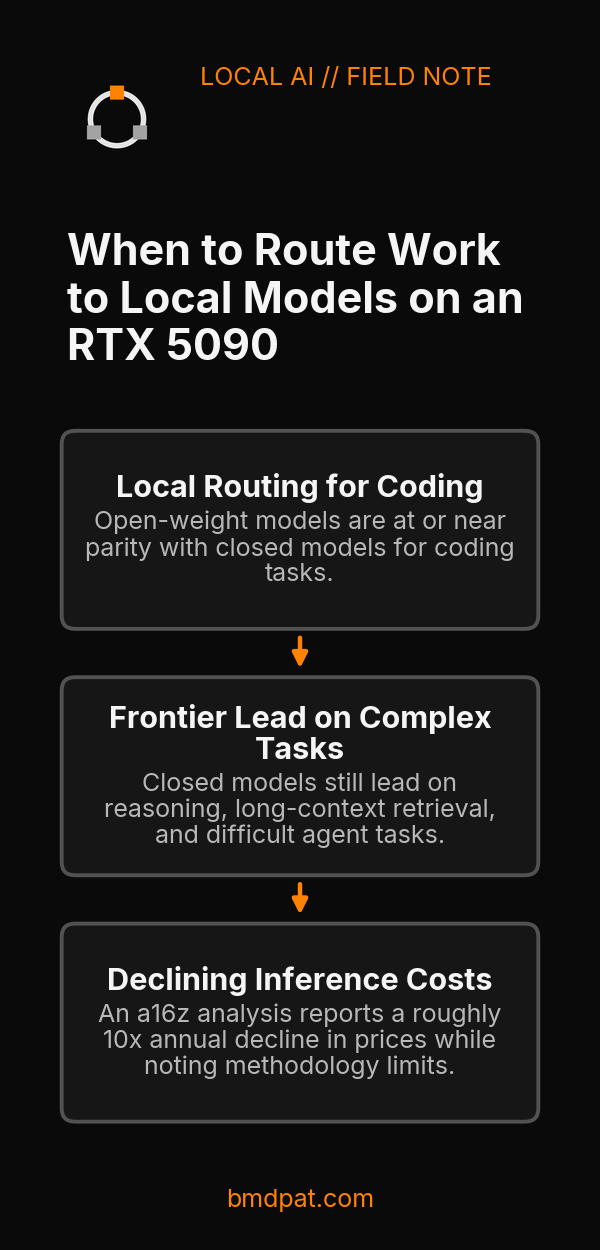
- Open-weight models are at or near parity with closed models for coding, but closed models still lead on reasoning, long-context retrieval, and difficult agent tasks.
- The State of Open Source AI report tracks GPT-4-class inference falling from a private dollar amount to a private dollar amount per 1M tokens over 36 months, labeling the detailed chart as 50x.
- An analysis by a16z reports a roughly 10x annual decline in equivalent-capability inference prices while explicitly noting methodology limits.
- An OpenRouter study of 100 trillion tokens showed open weights taking a majority of token volume by mid-2026, though not request count.
You should route repetitive coding tasks to local open weights on an RTX 5090 and keep difficult reasoning, long-context retrieval, and multi-step agent workloads on frontier APIs.
 Open full-size image (opens in new tab)
Where do open weights match cloud models?
Open-weight models match closed cloud models on coding tasks and general text transformation, making them ready for local execution on owned hardware. You can run these bounded tasks locally with predictable execution times and zero API fees, while saving paid remote tokens for tasks that demand complex reasoning.
The primary evidence comes from the State of Open Source AI report. The report finds that open models sit at or near coding parity with closed models. It also notes that open-weight production token share reached a majority by mid-2026. That finding is based on an OpenRouter study covering 100 trillion tokens, alongside OpenRouter live leaderboard tracking.
The report adds a crucial detail: that lead is token volume, not request count. High-volume, high-token jobs like code generation, refactoring, and text formatting account for this shift. If you run an RTX 5090, you can review our 5090 local inference guide to see how local execution handles these bounded coding jobs.
Where does the gap between open and closed models remain?
The performance gap concentrates in complex reasoning, long-context retrieval, multimodality, and difficult agent tasks. When a task requires chained logical steps or pulling needles out of huge context windows, closed frontier APIs still hold a clear operational edge.
Do not send open weights every job. The primary report states clearly that open models remain behind closed frontier models on reasoning benchmarks and multi-step tool use. If an agent must coordinate several tools across unknown state changes, running an open model locally often fails at early planning steps.
Local builders waste time when they treat open weights as an all-or-nothing replacement for APIs. Running an owned GPU does not remove hardware costs, power bills, operator time, or output verification. Use our VRAM calculator to check whether a model fits in 32 GB of VRAM before starting. If your task needs broad context retrieval or subtle reasoning, keep it on a commercial endpoint.
How fast are inference costs dropping across the market?
Published research shows inference prices falling rapidly across both open and closed endpoints, though researchers disagree on the exact headline multiplier. Lower cloud prices reduce the pressure to run every workload locally, forcing builders to justify local hardware through control and predictable throughput.
Consider the price tracking data. In its detailed section, the State of Open Source AI report displays GPT-4-class inference dropping from a private dollar amount to a private dollar amount per 1 million tokens over 36 months. It labels that detailed chart as a 50x decline.
However, the primary report contains an internal contradiction. Its summary card renders -29x, while the detailed section charts the move from a private dollar amount to a private dollar amount as 50x. The endpoint math shows 50x, but the published labels on the page do not agree with each other.
Independent analysis confirms the downward trend. Research published by a16z on inference costs reports a roughly 10x annual decline in equivalent-capability inference costs based on historical MMLU benchmarks. The a16z authors explicitly note methodology limits in tracking model quality over time. Even with those limits, cheap tokens mean local hardware must be chosen for specific workloads rather than vague cost savings.
Which tasks belong on your RTX 5090?
You should place high-token, syntax-heavy tasks on your RTX 5090 and keep broad planning on cloud endpoints. This split matches the measured strengths of open weights while avoiding context retrieval failures on local hardware.
| Workload Type | Recommended Target | Evidence From Source Pack |
|---|---|---|
| Repetitive code generation | Local RTX 5090 | Open weights are at or near coding parity |
| Script refactoring and tests | Local RTX 5090 | Open models hold majority token volume on OpenRouter |
| Difficult multi-step reasoning | Closed API | Closed models maintain a documented lead in reasoning |
| Large-file context retrieval | Closed API | The report notes open weights trail on long-context retrieval |
| Tool-calling agent workflows | Closed API | Difficult agent tasks remain a documented closed-model lead |
Before loading weights, read our GGUF quantization explained breakdown. Quantized weights let you fit larger parameter counts onto an RTX 5090, but quantization does not close the underlying gap in agent planning.
What should you do with this?
- Inventory your daily generation tasks and split them into coding tasks versus complex reasoning or long-context retrieval jobs.
- Load an open-weight model on your RTX 5090 to handle code generation, syntax corrections, and repetitive unit tests.
- Route multi-step agent plans and documents requiring wide context windows to closed API endpoints.
Accompanying prompt
What the prompt does: This prompt classifies incoming software engineering tasks into local RTX 5090 execution or remote frontier API calls based on verified capability gaps.
Copy/paste this prompt:
Copy-ready prompt
Paste the exact block into your coding agent.
No article chrome, no footnotes, no formatting drift.
This prompt and every other one we publish live in the free prompt library.
Copy the block above.
Weekly measured local runs: https://bmdpat.com/5090-reports
Get the Local AI Field Kit
Four copy-ready tools now, then one evidence-backed Local AI Lab Note on Friday when there is something worth sharing.
Try the free agent run check firstGet the requested artifact now, then at most one evidence-backed Local AI Lab Note on Friday when there is something worth sharing. One-click unsubscribe. No sponsored placements. Privacy.
Written by
Patrick Hughes
I build BMD and publish measured AI runs, failure reports, and reusable checks. Nashville, Tennessee.
More writing
- 5 min
Six PRs Went to Two and the Devlog Was the Bug
On 2026-11-21 I cut six open pull requests to two, freed 14.6 GiB on C:, and found the missing date import behind the devlog hole.
- 5 min
Full Precision vs Q8 vs Q6 vs Q4: Which Weights to Run?
Compare full precision vs Q8 vs Q6 vs Q4 weight sizes, memory needs, and measured speeds so you can pick the right GGUF quant for your local setup.
- 5 min
llama.cpp 1.0.0 release november 2026
The llama.cpp 1.0.0 release in November 2026 sets SemVer rules, cuts 35 deprecated functions, and adds FP8 KV caches. Here is what to check in your setup.
- 5 min
OpenClaw: Who Is Using It? Demographics Survey 2026
See verified 2026 OpenClaw survey demographics, user limits, and real sample metrics to help you evaluate your local AI agent setup against real data.
- 5 min
LLM GPU Costs Unexpectedly High: How to Diagnose the Bill
When LLM GPU costs are unexpectedly high, idle replica minutes, cold starts, and separate disk fees inflate invoices. Here is how to audit your runtime spend.