llama.cpp 1.0.0 release november 2026
The llama.cpp 1.0.0 release in November 2026 sets SemVer rules, cuts 35 deprecated functions, and adds FP8 KV caches. Here is what to check in your setup.
 Open full-size image (opens in new tab)
The llama.cpp 1.0.0 release in November 2026 arrived on November 13 alongside ggml v1.0.0, establishing formal Semantic Versioning for libllama and libggml while removing 35 deprecated C API functions. It introduces FP8 KV caches and server features, but the release notes establish no universal inference speed improvement.
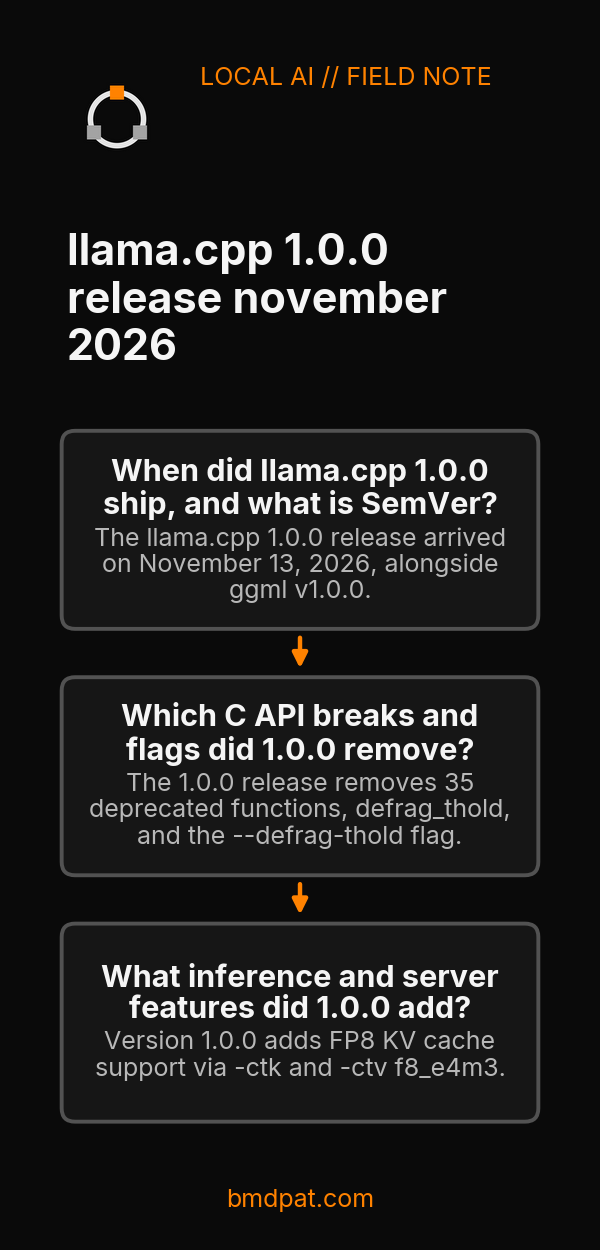
When did llama.cpp 1.0.0 ship, and what is SemVer?
The llama.cpp 1.0.0 release arrived on November 13, 2026, alongside ggml v1.0.0. Semantic Versioning now binds libllama and libggml. Major version numbers indicate incompatible C API updates, minor numbers add backward-compatible capabilities, and patch releases supply bug fixes. Downstream code gets explicit compatibility guarantees for the first time.
Before this release, developers tracking the repository pulled rolling development tags. According to the Hugging Face blog overview (https://huggingface.co/blog/ggml-org/llama-cpp-v1), the project team names libllama and libggml as official released libraries. Major versions signal breaking changes, minor versions add compatible features, and patch versions fix bugs.
If you build on top of these C libraries, this shift changes maintenance. You no longer guess whether a pull request breaks your application. However, library stability does not ensure permanent CLI or HTTP endpoint compatibility. When planning local LLM inference on consumer GPUs, pinning your build to a release tag protects your production stack.
Which C API breaks and flags did 1.0.0 remove?
The 1.0.0 release removes 35 deprecated functions, defrag_thold, and the --defrag-thold flag. The release also drops llama_set_warmup, moves the NextN API into llama.h, and renames llama_set_embd_state_src to llama_set_ctx_state_src. Any project linking directly against older libllama headers requires code audits and recompilation before deploying this update.
According to the official GitHub release notes (https://github.com/ggml-org/llama.cpp/releases/tag/v1.0.0), code relying on legacy memory management fails against v1.0.0. Removing llama_set_warmup means initialization logic must handle warmups explicitly. Deleting defrag_thold and --defrag-thold removes outdated defragmentation options.
If you maintain bindings, check your header references. The team moved NextN into llama.h. If your code used llama_set_embd_state_src, update your calls to llama_set_ctx_state_src. These changes require direct refactoring in any wrapper interacting with older C headers.
What inference and server features did 1.0.0 add?
Version 1.0.0 adds FP8 KV cache support via -ctk and -ctv f8_e4m3. It also adds host-memory MoE caching through moe_cache_size and moe_cache_cpu_share parameters. The llama-server binary adds a /v1/audio/speech endpoint alongside security fixes for SSRF, CORS, and DNS rebinding. These runtime additions expand memory management options without altering underlying model weight quantization formats.
The release notes detail two specific memory capabilities (https://github.com/ggml-org/llama.cpp/releases/tag/v1.0.0):
- FP8 KV Caching: Set with
-ctk f8_e4m3and-ctv f8_e4m3. This reduces the VRAM required for context. Calculate your exact memory envelope using the VRAM calculator. - Host-Memory MoE Caching: Controlled by
moe_cache_sizeandmoe_cache_cpu_shareinllama_context_params. This keeps Mixture of Experts routing data in system RAM.
These settings are runtime configurations, not model quantization formats. Meanwhile, llama-server gained a /v1/audio/speech endpoint and security fixes for SSRF, CORS, and DNS rebinding. A listed fix does not prove a setup is secure, so keep local network boundaries intact.
How do official releases differ from development builds?
Official releases follow vX.Y.Z tags and use -DLLAMA_BUILD_IS_DEV=OFF during CMake configuration. Daily development builds follow b[NUM] tags and build with -DLLAMA_BUILD_IS_DEV=ON. Tagged releases provide fixed boundaries for library stability, whereas development builds offer unreleased fixes or experimental backends that require recording exact commit revisions.
As discussed in ggml repository discussions (https://github.com/ggml-org/ggml/discussions/1579), tagged releases provide stable milestones, while development builds track rapid commits.
The tagged build guide (https://github.com/ggml-org/llama.cpp/blob/v1.0.0/docs/build.md) provides the default CPU build recipe:
cmake -B build
cmake --build build --config Release
For release builds, pass -DLLAMA_BUILD_IS_DEV=OFF to CMake. For development builds, pass -DLLAMA_BUILD_IS_DEV=ON.
If you run Ollama, engine updates depend on when Ollama pulls upstream changes. An earlier article on Ollama and llama.cpp feature compatibility explains that check. Historical tests with Ollama 0.31.2 on llama3.1:8b showed warm speeds of 173.13, 174.91, and 173.34 tok/s. Those figures reflect an older test, not a v1.0.0 benchmark. The source pack contains no measured benchmarks for v1.0.0, and the release does not establish a universal speed increase. Use our llama.cpp n-gpu-layers guide to manage offloading.
What should you do with this?
You should audit your code for removed functions, evaluate FP8 KV cache memory savings, and choose between tagged releases or development builds. Start by inspecting header calls, test your memory pressure on local hardware, and document the exact build flags your production environment relies on.
Follow these three steps in your local setup:
- Audit code for removed C API calls. Check codebases for
llama_set_warmup,defrag_thold,--defrag-thold, andllama_set_embd_state_src. Rename calls tollama_set_ctx_state_srcand import NextN fromllama.h. - Test FP8 context caching. When context fills GPU memory, test
-ctk f8_e4m3and-ctv f8_e4m3to observe VRAM savings on your card. - Set your CMake build flag. Use
-DLLAMA_BUILD_IS_DEV=OFFfor tagged release deployments, or record the commit hash when running-DLLAMA_BUILD_IS_DEV=ONfor development builds.
Accompanying prompt
What the prompt does: This prompt audits your local llama.cpp environment against the breaking changes and cache settings introduced in the 1.0.0 release.
Copy/paste this prompt:
Copy-ready prompt
Paste the exact block into your coding agent.
No article chrome, no footnotes, no formatting drift.
This prompt and every other one we publish live in the free prompt library.
Copy the block above.
Weekly measured local runs: https://bmdpat.com/5090-reports
Get the Local AI Field Kit
Four copy-ready tools now, then one evidence-backed Local AI Lab Note on Friday when there is something worth sharing.
Try the free agent run check firstGet the requested artifact now, then at most one evidence-backed Local AI Lab Note on Friday when there is something worth sharing. One-click unsubscribe. No sponsored placements. Privacy.
Written by
Patrick Hughes
I build BMD and publish measured AI runs, failure reports, and reusable checks. Nashville, Tennessee.
More writing
- 5 min
Software to Control Runaway Agent Loops That Burn Tokens
Stop runaway agent loops with CLI turn caps, graph recursion limits, Python guards, or proxy budgets before token burn exhausts your API credits.
- 5 min
OpenClaw: Who Is Using It? Demographics Survey 2026
See verified 2026 OpenClaw survey demographics, user limits, and real sample metrics to help you evaluate your local AI agent setup against real data.
- 5 min
LLM GPU Costs Unexpectedly High: How to Diagnose the Bill
When LLM GPU costs are unexpectedly high, idle replica minutes, cold starts, and separate disk fees inflate invoices. Here is how to audit your runtime spend.
- 5 min
Is OpenClaw Worth It? Setup Costs and Risks
OpenClaw offers free self-hosted messaging agents under the MIT license, but model token fees, host security, and skill audits determine your real costs.
- 5 min
OpenClaw AI Assistant Latest News 2026
OpenClaw release v2026.10.4 repairs sleep restarts and Tlon permissions, following skill discovery, MCP Apps, and R2 backup updates in October 2026.