Mojo Is Open Source. What Local AI Builders Need to Know
Modular put Mojo under Apache 2.0 with LLVM exceptions on August 18, 2026. Here is what the release changes for local AI builders, and what it does not.
TL;DR
- Modular lists Mojo as fully open source under the Apache 2.0 license with LLVM exceptions. The announcement is dated August 18, 2026. Modular says Mojo hit 1.0 the week before.
- The repository README puts MAX usage and distribution under the Modular Community License, not Apache 2.0. Qualcomm completed its acquisition of Modular on July 29, 2026.
- Baseline from the 2026-08-20 5090 Reports table: llama3.1:8b at Q4_K_M, Ollama 0.31.1, RTX 5090, driver 610.88, 32,607 MiB. short-gen-256: 228.87 tok/s, 7,170 MiB peak VRAM, 111 W average and 439 W peak, done_reason=length.
Modular now lists Mojo as fully open source under the Apache 2.0 license with LLVM exceptions. The announcement is dated August 18, 2026. Modular says Mojo hit 1.0, with source stability, the week before.
The practical change for local AI builders is lower lock-in risk. It is not a new benchmark result.
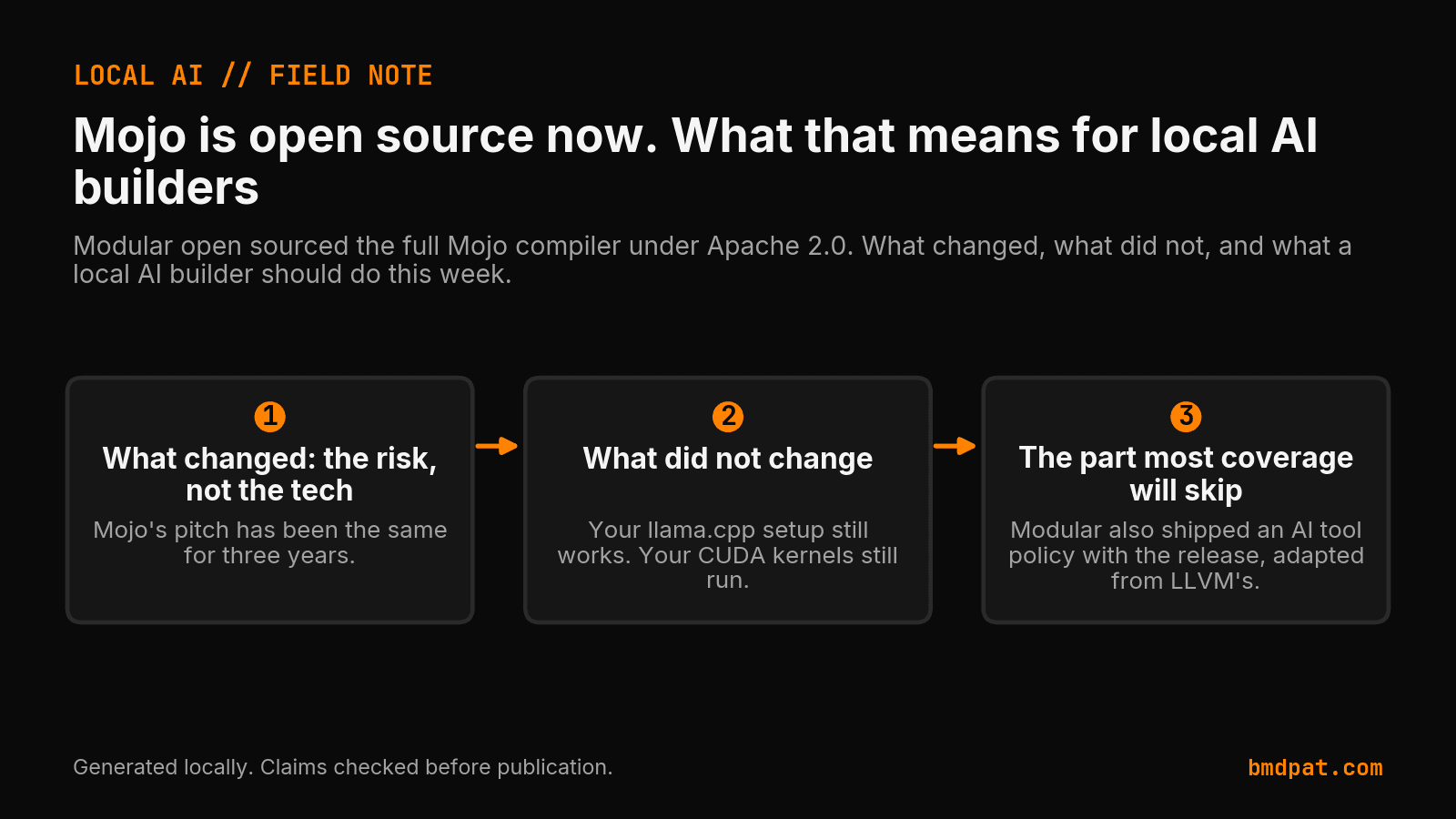
What changed when Mojo went open source?
Modular describes Mojo as a general purpose programming language built to unlock GPUs, AI accelerators, and other advanced compute. Its syntax aims to stay readable while giving builders low-level control.
The product pitch is familiar. The source boundary changed.
Before August 18, 2026, the compiler was closed even though Modular had an open community around Mojo. A public source tree gives you an exit path if the project changes direction.
Now the compiler and the toolchain sit in a public repository under Apache 2.0 with LLVM exceptions. You can read the code, track changes, and check whether the license fits your use.
One boundary is still there. The repository README puts MAX usage and distribution under the Modular Community License, not Apache 2.0. An open compiler does not make the whole stack open. Check the license on the exact part you plan to ship.
One more fact belongs in a lock-in argument. Qualcomm completed its acquisition of Modular on July 29, 2026, three weeks before this release. Modular's site footer now reads "Modular Inc, A Qualcomm Company." New owner first, open source second. Read the public source tree as the exit path it gives you, not as a promise about direction.
What did not change for local GPU performance?
This announcement does not report a new benchmark for your card. It does not replace a test of your llama.cpp or CUDA path.
1.0 plus open source means it is now safe to evaluate. It is not proof of performance on consumer GPUs. I have not seen measured numbers for RTX-class cards from an independent source, and I will not repeat vendor benchmarks here.
Until then: evaluate, do not migrate.
What baseline should you record before you test Mojo?
Here is mine, from the 5090 Reports benchmark table dated 2026-08-20. Model llama3.1:8b at Q4_K_M, served by Ollama 0.31.1 on an RTX 5090, driver 610.88, 32,607 MiB of memory.
Workload short-gen-256: 46 input tokens, 256 output tokens, num_ctx=4096, num_predict=256, temperature=0. Result: 228.87 tok/s, 7,170 MiB peak VRAM, 111 W average and 439 W peak draw, done_reason=length.
That row is the bar. It is one model, one quantization, one workload, on one card. Mojo has to beat it on the same task, at the same settings, on the same card, before any of my inference path moves.
Write your own row down before you install anything. Model, quantization, engine version, context size, output cap, tokens per second, peak VRAM, stop reason. Without the stop reason and the output cap you cannot tell a real speedup from a run that quit early.
What does Modular's AI tool policy require?
Modular also ships an AI tool policy adapted from LLVM's. If you build with coding agents, this document may matter more to you than the compiler does. The rules:
- Label AI-assisted work with an
Assisted-by: AIcommit trailer or PR description. - Keep PRs under 100 lines of code whenever possible.
- Write the PR description yourself. The policy allows AI tools for translation or copy-editing.
- Read and review all AI-generated code or text before you ask other project members to review it.
- Do not run agents that act in the project's spaces without human approval. Bots that automatically open or comment on issues and PRs are the named example. An opt-in tool that keeps a human in the loop is acceptable.
- Meet the project's normal standards for code quality, testing, and correctness, whatever tool wrote the change.
Their reasoning is the sharpest one-line summary of the agent era I have read: AI lowers the cost of generating code, not reviewing it. Unreviewed AI output sent to maintainers takes design and review time from them, and the policy calls that an extractive contribution. It credits the term to Nadia Eghbal.
The label is conditional, not automatic. Maintainers apply the extractive label when an issue or PR is clearly off-track. The policy says the call cannot be weighed objectively, and it leaves the decision to the maintainers doing the work.
One timing note before you act on any of it. Modular says it is not ready to take contributions to the compiler and tooling, and it aims to accept them by the end of 2026. The Mojo standard library has accepted contributions since 2024, so that is where the door is open.
If you run coding agents against open-source repos, read the document before you submit a change. If you maintain a repo, its rules give you a useful starting point.
What should a local AI builder do after the August 18, 2026 release?
- Read the repo, not only the announcement. The code and contributor guides tell you how the project works.
- Start with a small change in a part of the project that already accepts contributions. Open an issue first when the project asks for design discussion.
- If you ship agent-written code, adopt the
Assisted-by:label in your own projects. Keep a human responsible for the final change. - Record the baseline row above for your own card before you install the toolchain.
Step 4 is the whole point. A license change is not a speed change. Move only when your own receipt says so.
Related reading
- My local LLM eval hid four token caps
- A GPU Driver Is Not a Local LLM Benchmark
- The 26B Model Hit the Cap. The 8B Finished.
- A 27B Model Fit on an 8 GB GPU. It Was Slow.
Accompanying prompt
What the prompt does: It turns an open-source AI tool announcement into a small, reviewable local evaluation plan.
Copy/paste this prompt:
Copy-ready prompt
Paste the exact block into your coding agent.
No article chrome, no footnotes, no formatting drift.
This prompt and every other one we publish live in the free prompt library.
Copy the block above.
Get the artifact-backed local AI lab notes by email: https://bmdpat.com/5090-reports
FAQ
What changed when Mojo went open source?
The compiler and toolchain now sit in a public repository under Apache 2.0 with LLVM exceptions. MAX usage and distribution stay under the Modular Community License. Qualcomm acquired Modular on July 29, 2026, three weeks before this release.
What did not change for local GPU performance?
The announcement does not report a new benchmark for a consumer GPU. 1.0 plus open source means it is now safe to evaluate. It is not proof of performance on RTX-class cards.
What does Modular's AI tool policy require?
Label AI-assisted work with an Assisted-by: AI trailer, keep PRs under 100 lines of code whenever possible, write the PR description yourself, review all AI-generated code before asking maintainers to review it, and do not run unattended agents in the project's spaces.
Get the Local AI Field Kit
Four copy-ready tools now, then one evidence-backed Local AI Lab Note on Friday when there is something worth sharing.
Try the free agent run check firstGet the requested artifact now, then at most one evidence-backed Local AI Lab Note on Friday when there is something worth sharing. One-click unsubscribe. No sponsored placements. Privacy.
Patrick Hughes
I build BMD and publish measured AI runs, failure reports, and reusable checks. Nashville, Tennessee.
More writing
- 5 min
My local LLM eval hid four token caps
My 5090-rig eval uses four output caps: 50, 180, 192, and 256 tokens. A score without the cap is not a model result. Record the cap on every row.
- 5 min
Bonsai 27B vs Gemma 4 E4B: Which Should You Run?
Compare Ternary Bonsai 27B and Gemma 4 E4B for local AI. See VRAM footprints, multimodal support, benchmark scores, and run commands for your setup.
- 5 min
q4_k_m vs q8_0: which GGUF quant should you use?
Compare Q4_K_M and Q8_0 for Llama 3.1 8B. Learn how quantization affects file size, VRAM usage, perplexity, and generation speed on local hardware.
- 5 min
Local or API? Test the task before routing it
Compare a local model with an API on the same task. Record settings, failed attempts, review time and cost before you decide where the workload belongs.
- 6 min
Build an AI Research Workbench on Your Own GPU
Claude Science keeps data on local systems but sends selected context to Claude. Here is the owned-GPU version, with measured RTX 5090 costs.