Log Local LLM Fallbacks Before You Score the Output
My local writer hit a host RAM guard, then Sonnet produced a draft that failed QA. Here is how I separate availability, model identity, and useful output.
My local writing job produced a draft on September 7. That sounds like a working local model until I read which model wrote it.
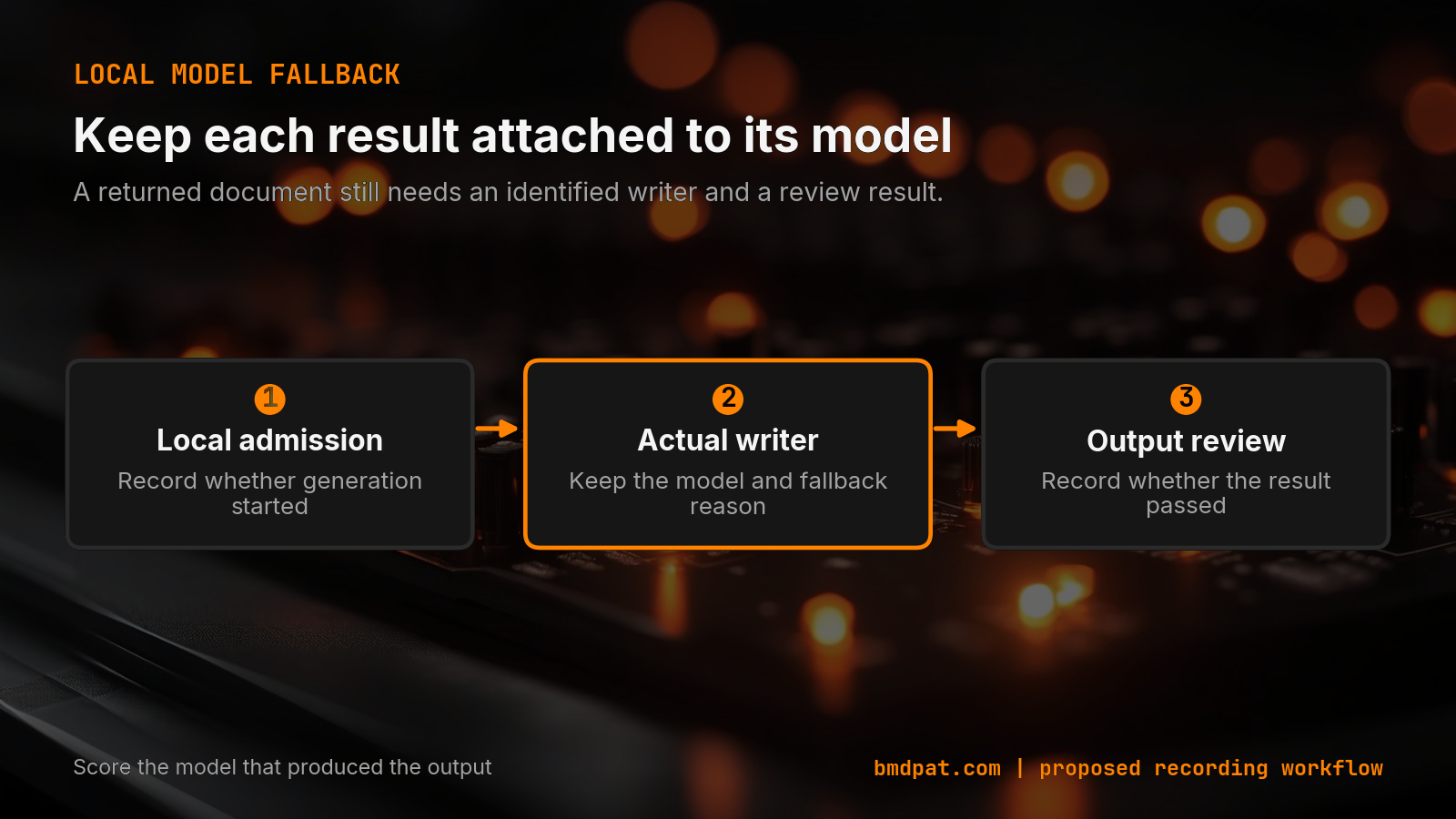
A fallback can finish generation while the local path remains unavailable. Record the requested model, the actual writer, and the output's review result separately. A returned document proves only that something returned a document.
 Open full-size image (opens in new tab)
What happened on my local writing job?
My preferred writer is gemma4:26b through Ollama on the RTX 5090 machine. The September 7 draft records a cold-load refusal: free_ram_gib=15.91 minimum=16.0. That minimum is my host admission policy. It is not a published memory requirement for Gemma or Ollama.
The writer code checks capacity before it sends the generation request. In this case, the saved reason says the local path stopped at that check. There is no local generation speed to report from that attempt.
The fallback produced text. The draft metadata names claude-sonnet-5 as the writer and claude-cli as the runtime. Those are the identifiers recorded by my pipeline, not a comparison of model capability. The append-only draft receipt also records the Sonnet writer.
Independent review then requested changes. It found unsupported claims, public-pricing placeholders, and a claim about an ongoing hardware comparison without a matching receipt. The draft stayed unpublished. These observations come from my September 7 writer metadata, draft receipt, and review record. They are one workflow result, not a benchmark of either model family.
Which result belongs to the local model?
The local result is an admission refusal. The hosted result is a generated draft that did not pass review. Combining them into one successful local run would give Gemma credit for text it never wrote. Combining them into one local quality failure would blame Gemma for text it never wrote.
That is the mistake I want a run record to prevent. Keep the local attempt visible even when another provider completes the request. Attach review findings to the output and the writer that produced it.
I covered the memory boundary in host RAM headroom for local LLMs. This case adds the next question: after a refusal, where did the work go?
What should I save before scoring a fallback?
I would put these fields beside the existing job result: requested model, actual model, runtime, fallback reason, whether local generation started, and final review status. Keep the original attempt and the fallback connected by the same job identifier. Avoid replacing the requested model field with the fallback model and losing the route history.
Save the failure reason as observed. A host-memory refusal, an unavailable endpoint, and a malformed response need different fixes. A single error label such as model failed cannot tell me whether to adjust scheduling, repair a connection, or examine the output parser.
For an Ollama diagnostic snapshot, the official FAQ documents ollama ps. It lists loaded models and shows whether they occupy GPU memory, system memory, or both. That helps inspect residency. It does not prove which model wrote an earlier file. The request and response record must establish that link.
Does fallback completion mean the workflow recovered?
I use separate questions. Did the preferred local path run? Did a permitted alternative return output? Did that output pass the check required for the job? On September 7, the evidence answers no, yes, and no.
Those answers suggest different actions. The first calls for investigating available host capacity. The second confirms that generation continued through the configured alternative. The third keeps the document out of publication until its factual problems are fixed.
My local LLM benchmark decision record puts quality before speed. Fallback adds an attribution rule before either: establish which model produced the result. Otherwise, a quality score or duration can end up attached to the wrong machine.
When should I keep the job local and wait?
If the task requires private hardware throughout, a cloud fallback changes the data boundary. I would keep that job pending or select an allowed local alternative. The existence of a callable hosted model does not establish permission to send the input there.
For tasks that allow a hosted fallback, retain the failed local attempt and label the actual output. Keep each provider's duration and usage separate. Do not include fallback text in a local model's acceptance rate or describe it as measured GPU output.
My rule is simple: score the model that did the work, and record why the preferred model did not. That makes a recovered generation useful evidence without turning it into a false local-model result.
Accompanying prompt
What the prompt does: Audits a local model job for fallback attribution and separates generation from accepted output.
Copy/paste this prompt:
Copy-ready prompt
Paste the exact block into your coding agent.
No article chrome, no footnotes, no formatting drift.
This prompt and every other one we publish live in the free prompt library.
Copy the block above.
Join the email list for measured local AI build notes: https://bmdpat.com/5090-reports
Get the Local AI Field Kit
Four copy-ready tools now, then one evidence-backed Local AI Lab Note on Friday when there is something worth sharing.
Try the free agent run check firstGet the requested artifact now, then at most one evidence-backed Local AI Lab Note on Friday when there is something worth sharing. One-click unsubscribe. No sponsored placements. Privacy.
Written by
Patrick Hughes
I build BMD and publish measured AI runs, failure reports, and reusable checks. Nashville, Tennessee.
More writing
- 5 min
Agent Memory: Test the Answer After a Correction
Our agent-memory replay checks words in a file. I show what that proves, what it misses, and how to test whether an expert correction changes an answer.
- 5 min
My local daily brief used 0 model calls
On September 4, 2026 my llama3.1:8b daily brief was ready with 0 model calls and 0 seconds. Preview-only file ranking is not a model run.
- 5 min
Long Context Cost Me VRAM, Not Tokens a Second
A 94x bigger prompt cost llama3.1:8b only 9.7% of its generation rate. VRAM rose 656 MiB, but num_ctx doubled in the same step. Budget memory first.
- 5 min
One model logged 14.5 and 6,178 prompt tokens a second
gemma4:26b read 53 prompt tokens at 14.5 tok/s and 4,470 at 6,178.9 on the same RTX 5090 run set. Prompt speed is not one number.
- 5 min
Ollama Load Time Can Hide a Fast Local LLM
My RTX 5090 run spent 43.48 seconds on model load and 0.17 seconds on output. Split wall time before you judge local LLM speed.