Your Local LLM CSV Needs a Schema Version
I audited seven RTX 5090 benchmark CSVs and found four header widths, three power schemas, and no schema version. Here is the row contract I use now.
TL;DR
- Seven files hold 17 data rows. Their headers have 9, 10, 15, or 17 columns. None has a schema_version field. None has a run_id field.
- Power has three shapes: watts_before and watts_after, watts_avg (one row blank), and one file with no power column that puts 158W inside a notes sentence.
- Unit drift is the sharpest case: 2026-06-14 and 2026-07-09 files record total_duration_s, while 2026-08-02 v2 and 2026-08-04 files record total_duration_ms. A reader that ignores the suffix is wrong by a factor of 1000.
My RTX 5090 benchmark notebook has measured data I cannot compare without hand repair. The models are not the problem. The CSV files disagree about what a benchmark row is.
The short answer: I audited seven local LLM benchmark CSVs on 2026-08-28. They contain 17 rows across four header widths, three power-field shapes, and zero schema_version fields. A benchmark file needs a versioned row contract before it needs another model run.
Canonical URL: https://bmdpat.com/blog/local-llm-benchmark-csv-schema-version-2026
What did the CSV audit find?
I read every CSV under my 5090 benchmark folder and compared the headers before I compared the results.
Seven files hold 17 data rows. Their headers have 9, 10, 15, or 17 columns. None has a schema_version field. None has a run_id field. Two files have captured_at; the other five do not.
Power has three shapes. Two files store watts_before and watts_after. Four files declare watts_avg, although one row leaves it blank. One file has no power column and puts 158W inside a notes sentence.
Those rows are still real measurements. The problem is that the reader must guess how each file maps into a common table.
Why does header drift break a benchmark notebook?
A CSV reader can join files only after someone decides which columns mean the same thing. watts_after is not the same measurement as watts_avg. A date is not the same as a timestamp. A runtime name is not a run identity.
Unit drift is the sharpest case. My 2026-06-14 and 2026-07-09 files record total_duration_s, eval_duration_s, and load_duration_s. My 2026-08-02 v2 and 2026-08-04 files record total_duration_ms, eval_duration_ms, and load_duration_ms. Same measurement, different unit, different name. The other three files carry no duration column at all. A reader that matches on the word duration and ignores the suffix is wrong by a factor of 1000.
Token rate splits the same way. Six files write tokens_per_second. One writes tok_per_sec. Those names map safely because both mean tokens per second. The values still do not compare, because that lone row is a five-task eval average and the others are single runs. A safe name mapping is not a safe comparison.
My daily 5090 report flattens all 17 rows into one display table. That makes the report readable, but it cannot recover fields that the collector never wrote. A blank power cell may mean not measured, not supported by that schema, or lost in free text.
I found the same boundary when I audited missing driver versions. The row must carry its own facts at capture time. A later report cannot add them without inventing history.
What belongs in a versioned row contract?
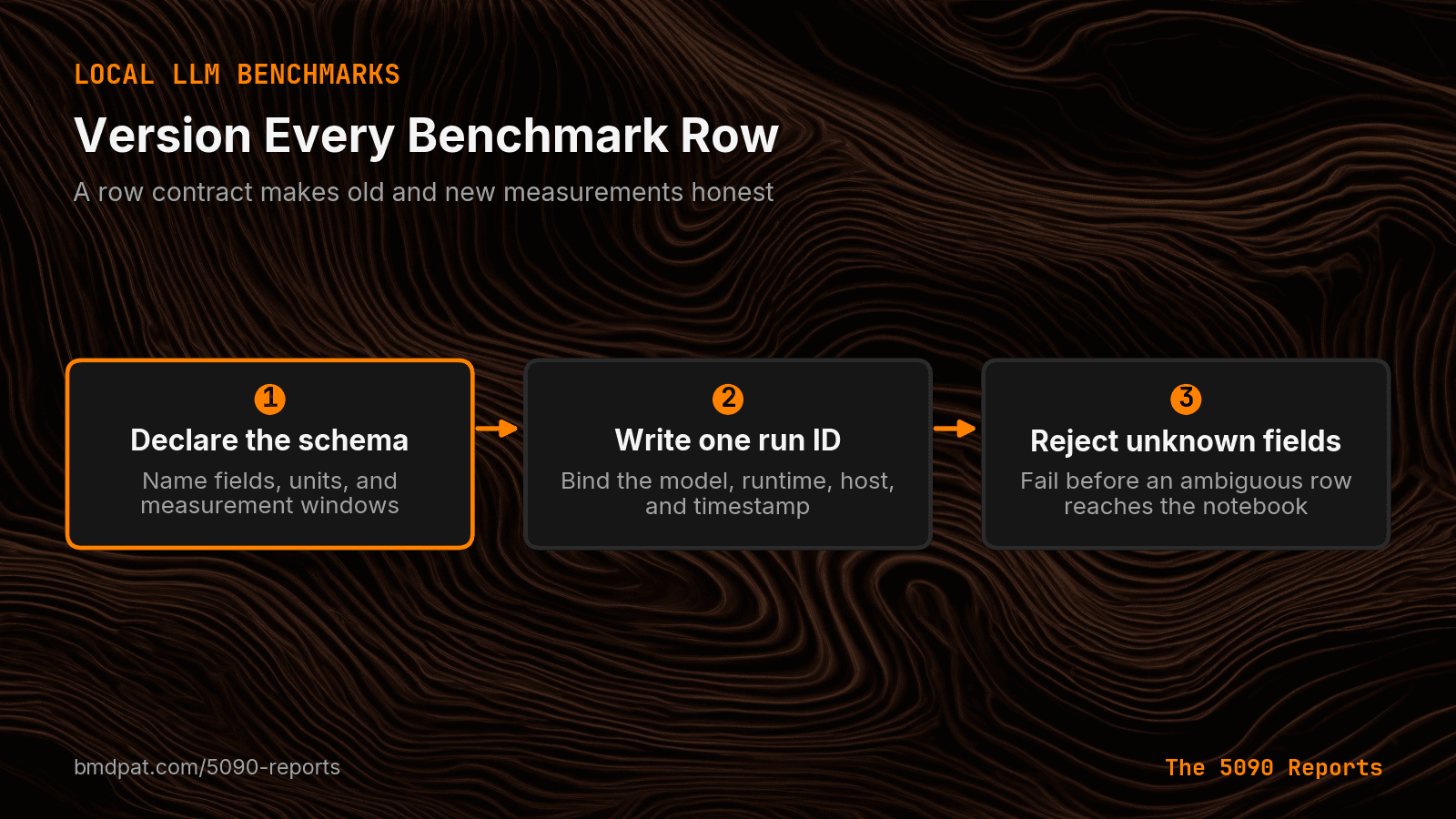
I now treat the CSV header as an API. Version one has four groups.
Identity fields name schema_version, run_id, and captured_at. Environment fields name the GPU, driver, runtime, runtime version, model, and quant. Workload fields record the task, input tokens, output tokens, context size, and stop reason. Result fields record wall time, load time, prompt time, generation time, token rate, VRAM, and power.
Each field needs one unit in its name or contract. load_duration_ms is clear. load_duration is not. watts_avg must mean an average sampled during the measured window, not the reading after the request ended.
The contract also needs explicit missing values. I use not_measured when the collector skipped a metric and not_supported when the runtime cannot expose it. An empty string is not enough because it hides the reason.
How should old benchmark rows move forward?
Do not rewrite old files to look current. Keep the original bytes and add a read-time adapter for each known header.
The adapter can map tokens_per_second and tok_per_sec into one output field because both source names remain visible in the mapping. It must not map watts_after into watts_avg. When no safe mapping exists, the normalized value stays unknown.
That preserves the measured result and the limits around it. It also lets a future collector write only the current schema while the report reader handles older files.
This is where power data needs a defined sample window. A schema name is useful only when its measurement rule is fixed too.
What should fail before a new row is saved?
The collector should reject a row with no schema version, run ID, capture timestamp, runtime version, or GPU name. It should reject numeric fields that carry units in the value instead of the contract. It should also reject unknown columns unless the schema version declares them.
Then test both sides. A complete current row should pass. A row copied from an old file should fail with the missing fields named in the error. That negative case matters because a permissive writer is how the notebook reached four header widths.
The fix is small. The collector owns one row contract. The report reader owns explicit adapters for old contracts. No human edits a benchmark row after the run.
Accompanying prompt
What the prompt does: It audits local LLM benchmark files for schema drift and writes a safe normalization plan without filling missing facts.
Copy/paste this prompt:
Copy-ready prompt
Paste the exact block into your coding agent.
No article chrome, no footnotes, no formatting drift.
This prompt and every other one we publish live in the free prompt library.
Copy the block above.
Get the next measured local AI build note from The 5090 Reports.
FAQ
What did the CSV audit find?
On 2026-08-28, seven local LLM benchmark CSVs contained 17 rows across four header widths (9, 10, 15, or 17 columns), three power-field shapes, and zero schema_version fields. Two files have captured_at; the other five do not.
Why does header drift break a benchmark notebook?
watts_after is not the same measurement as watts_avg. Duration columns mix _s and _ms names, so matching on the word duration without the suffix is wrong by a factor of 1000. A later report cannot recover fields the collector never wrote.
What belongs in a versioned row contract?
Identity fields name schema_version, run_id, and captured_at. Environment fields name the GPU, driver, runtime, runtime version, model, and quant. Workload and result fields record task, tokens, context, stop reason, timings, token rate, VRAM, and power, with units in the field name.
Get the Local AI Field Kit
Four copy-ready tools now, then one evidence-backed Local AI Lab Note on Friday when there is something worth sharing.
Try the free agent run check firstGet the requested artifact now, then at most one evidence-backed Local AI Lab Note on Friday when there is something worth sharing. One-click unsubscribe. No sponsored placements. Privacy.
Patrick Hughes
I build BMD and publish measured AI runs, failure reports, and reusable checks. Nashville, Tennessee.
More writing
- 5 min
Your Benchmark Row Never Saved the Driver Version
I audited seven RTX 5090 benchmark files on 2026-08-27. Not one records the GPU driver version. Here are the four fields every local LLM row needs.
- 5 min
Long Context Cost Me VRAM, Not Tokens a Second
A 94x bigger prompt cost llama3.1:8b only 9.7% of its generation rate. VRAM rose 656 MiB, but num_ctx doubled in the same step. Budget memory first.
- 5 min
One model logged 14.5 and 6,178 prompt tokens a second
gemma4:26b read 53 prompt tokens at 14.5 tok/s and 4,470 at 6,178.9 on the same RTX 5090 run set. Prompt speed is not one number.
- 5 min
The 26B Model Hit the Cap. The 8B Finished.
Same code task, same 512-token cap. Ollama's done_reason showed one local model finished and one got cut off. Tokens per second hid it.
- 5 min
How I Benchmark Local LLMs Before I Trust Them
A local LLM benchmark should end with a decision. I record task quality, tokens per second, VRAM, power, and failure state before I add a model.