Why I Did Not Promote My Smaller Local Model
My smaller local model existed and ran, but it did not beat the baseline. Here is the promotion gate I use before changing a working local AI route.
TL;DR
- The baseline was llama3.1:8b. The candidate was a local Qwen adapter on the same machine. The candidate file existed, so this was not a missing-path or download failure.
- The promotion check ran four times on July 20. Each run returned candidate_not_promotable. The candidate did not beat the baseline under the promotion rules.
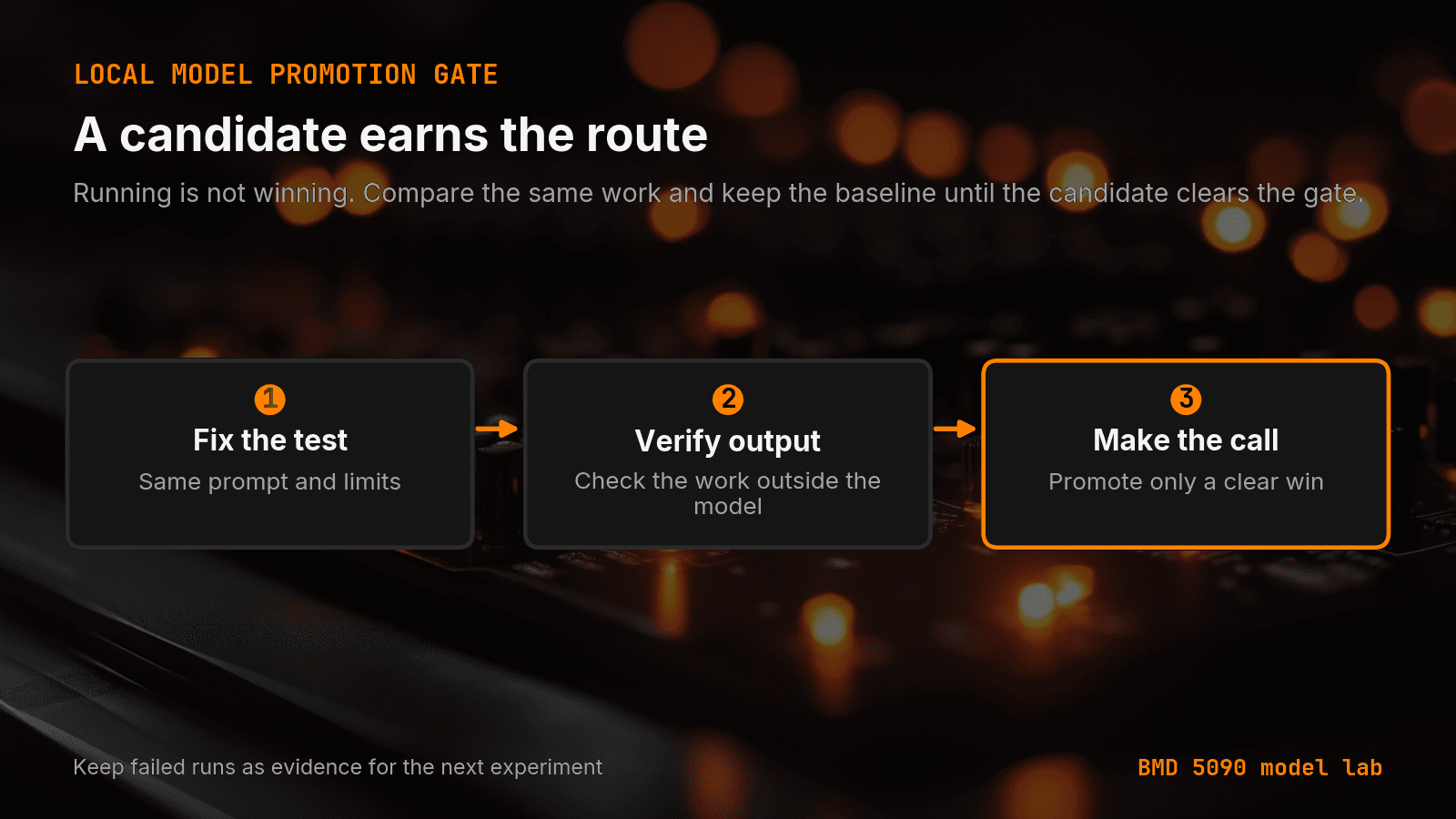
- Give baseline and candidate the same prompt, context, runtime settings, and output limit. Run the same verifier. A failed route decision is evidence about one workload, not a universal ranking.
A local model can exist, load, and answer prompts without earning a place in a working route. I hit that boundary on July 20, 2026, when a smaller candidate failed to beat the baseline on my RTX 5090 box.
The short answer: I keep the current model until a candidate wins under the same promotion rules. A smaller file or a successful load is not enough. The candidate must improve the work without breaking the checks that make the current route useful. Canonical URL: https://bmdpat.com/blog/local-model-promotion-gate-2026
What happened in the local model lab?
My baseline was llama3.1:8b. The candidate was a local Qwen adapter stored on the same machine. The candidate file existed, so this was not a missing-path or download failure.
I ran the promotion check four times on July 20. Each run returned the same result: candidate_not_promotable. The recorded reason was direct. The candidate did not beat the baseline under the promotion rules.
That is a useful result. The lab protected a working route from a change that had not earned its place. I kept the baseline and saved the failed decision as data for the next training or evaluation pass.
Why is a successful model run not enough?
Loading confirms the runtime can open the model. Generating text confirms the model can produce output. Neither shows the output is better for the job.
This distinction matters more with smaller local models. A smaller model may use less memory or return text faster. It may also miss required details, ignore output structure, or fail a verifier that the baseline passes. Speed only helps when the answer still clears the task gate.
I use the same rule in my local model verifier loop. The model does not grade itself. A separate check decides whether the result meets the contract.
What should a local model promotion gate compare?
Start with the work, not the model card. Give the baseline and candidate the same prompt, context, runtime settings, and output limit. Run the same verifier against both outputs.
Then compare the traits that matter for that route:
- Did the output satisfy every required field?
- Did the verifier pass without a manual repair?
- Did the model stay inside the allowed time and memory boundary?
- Did repeated runs keep the same useful behavior?
The exact weights depend on the job. A drafting model can tolerate a repair step if that repair is measured and cheap. A model that writes commands for an unattended job needs a much stricter correctness gate.
I do not combine those jobs into one vague quality score. I write the pass rule before the run. That keeps a fast but incomplete answer from winning because it feels better in the moment.
Why keep the failed result?
A rejection tells me what the next experiment must change. If I only store winners, I lose the boundary that made the winner meaningful.
For this run, the durable fact is simple: the adapter existed, the promotion code ran, and the candidate did not beat llama3.1:8b. I do not have enough evidence from that result to claim the smaller model is bad in general. I only know it did not win this route under this gate.
That phrasing matters. Local model work is full of broad claims drawn from narrow tests. A failed route decision is not a universal model ranking. It is evidence about one workload, one setup, and one acceptance rule.
The same discipline applies to throughput. My consumer GPU inference write-up explains why fit and speed are only part of production readiness. A model that fits the card still has to finish the real job correctly.
When should the smaller model get another chance?
I would retest after a real change: better training data, a corrected adapter export, a prompt contract that matches the target job, or a runtime setting that fixes a measured failure. I would not rerun the same candidate until random variation hands me a pass.
The next test should also keep the baseline fixed. If the baseline, prompt, and verifier all change at once, the comparison stops answering a clear question.
This is the boring part of local AI that saves the most time. Keep the route that works. Change one input. Record the result. Promote only when the candidate wins the job you actually need done.
Accompanying prompt
What the prompt does: It turns a local model replacement into a fixed comparison with explicit evidence and a clear promotion decision.
Copy/paste this prompt:
Copy-ready prompt
Paste the exact block into your coding agent.
No article chrome, no footnotes, no formatting drift.
This prompt and every other one we publish live in the free prompt library.
Copy the block above.
I publish measured local AI runs and the failures behind them in The 5090 Reports. Join the email list for the next result.
FAQ
Why not promote a smaller local model that loads?
Loading confirms the runtime can open the model. Generating text confirms output exists. Neither shows the output is better for the job. Speed only helps when the answer still clears the task gate.
What did the July 20 RTX 5090 promotion check show?
Four runs, all candidate_not_promotable. The Qwen adapter existed and the promotion code ran. It did not beat llama3.1:8b under those rules.
When should the smaller model get another chance?
After a real change: better training data, a corrected adapter export, a prompt contract that matches the job, or a runtime setting that fixes a measured failure. Keep the baseline fixed.
Get the Local AI Field Kit
Four copy-ready tools now, then one evidence-backed Local AI Lab Note on Friday when there is something worth sharing.
Try the free agent run check firstGet the requested artifact now, then at most one evidence-backed Local AI Lab Note on Friday when there is something worth sharing. One-click unsubscribe. No sponsored placements. Privacy.
Written by
Patrick Hughes
I build BMD and publish measured AI runs, failure reports, and reusable checks. Nashville, Tennessee.
More writing
- 6 min
Build an AI Research Workbench on Your Own GPU
Claude Science keeps data on local systems but sends selected context to Claude. Here is the owned-GPU version, with measured RTX 5090 costs.
- 5 min
How to Calculate Local LLM Energy per Token
My RTX 5090 test shows how watts and output rate become joules per token, and why the faster of two matched settings can waste energy.
- 4 min
Why a Failed Local LLM Benchmark Row Still Matters
A failed local LLM row marks the test boundary. My RTX 5090 report shows why quality, speed, and settings belong in one receipt.
- 5 min
llama-server ngl: How to Set and Verify GPU Offload
Learn how to set -ngl in llama-server, verify GPU layer offload in startup logs, avoid silent CPU fallback, and check device readiness.
- 5 min
What Does ngl 99 Mean in llama.cpp?
In llama.cpp, ngl 99 sets a numeric cap of 99 layers in GPU memory rather than 99 percent VRAM. Here is how layer offloading works and what to run.